Morning by morning
Open capture on the left, close capture on the right. Click any chart to enlarge.
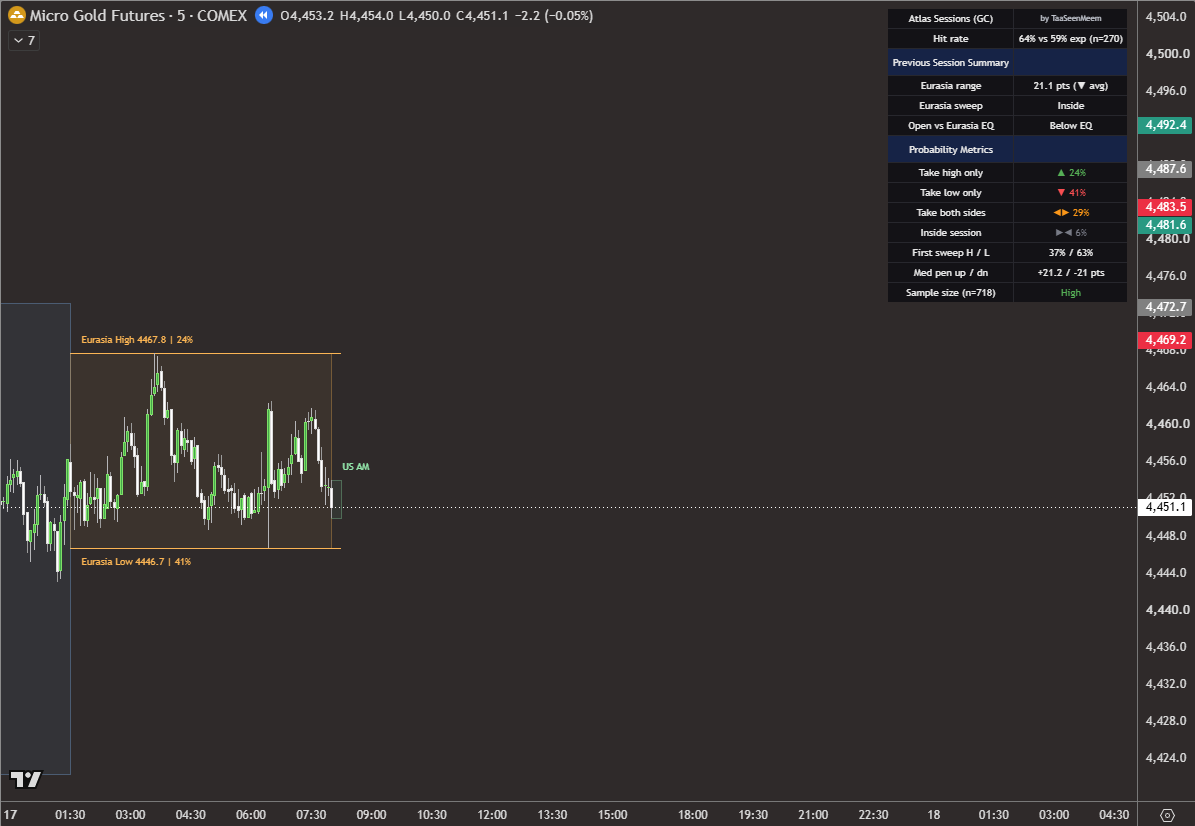
Eurasia high 4467.8 at 24%, low 4446.7 at 41%. Price below Eurasia EQ, a few points above the low.
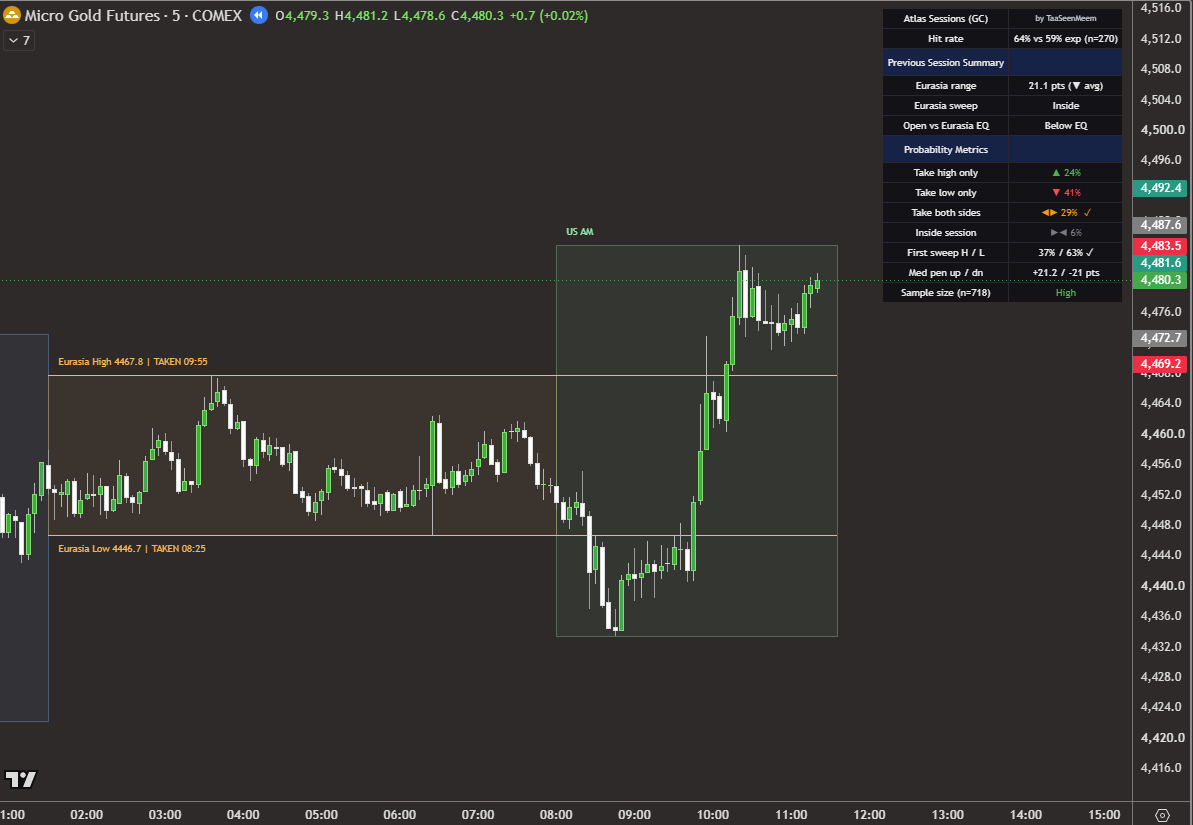
Low taken 08:25, high taken 09:55. Both sides, rated 29%; the 41% low-only favourite did not land.
The low first, as called, and then the session went and took the high as well
First sweep ✓ · modal branch ✗ · both sides, rated 29%Eurasia printed 21.1 points, below average and inside its own predecessor, and handed US AM an open a few points above its low. The tables put 63% on the low going first and it went at 08:25, on a dip to 4435 that was the session low.
From there gold climbed for ninety minutes, back through the whole Eurasia range, and took the high at 09:55. Both sides at 29% was the second-rated branch; low only at 41% was the favourite and did not land, so the morning scores on the first axis and not the second.
Axis 3 gives it two from two: the low at 70% went and the high at 53% went. A pair of levels twenty-one points apart is a pair that is hard to avoid in a session that travels forty-five, and the marginals said as much.
- Eurasia range21.1 pt, below average
- Prior sweepInside
- Open vs Eurasia EQBelow EQ
- Four-way24 / 41 / 29 / 6
- First sweep▲ 37% · ▼ 63%
- P(high taken)53% → taken 09:55
- P(low taken)70% → taken 08:25
- Samplen 718, High
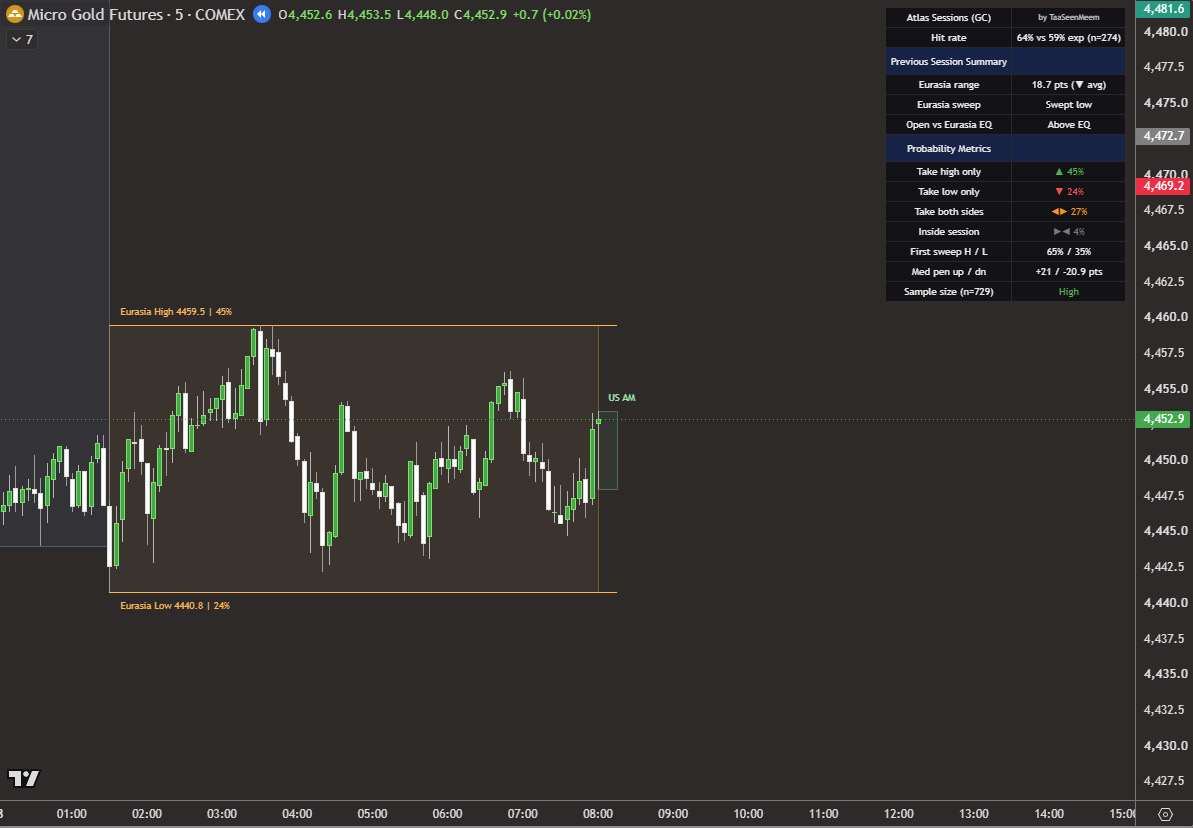
Eurasia high 4459.5 at 45%, low 4440.8 at 24%. Price above Eurasia EQ after Eurasia swept its own low.
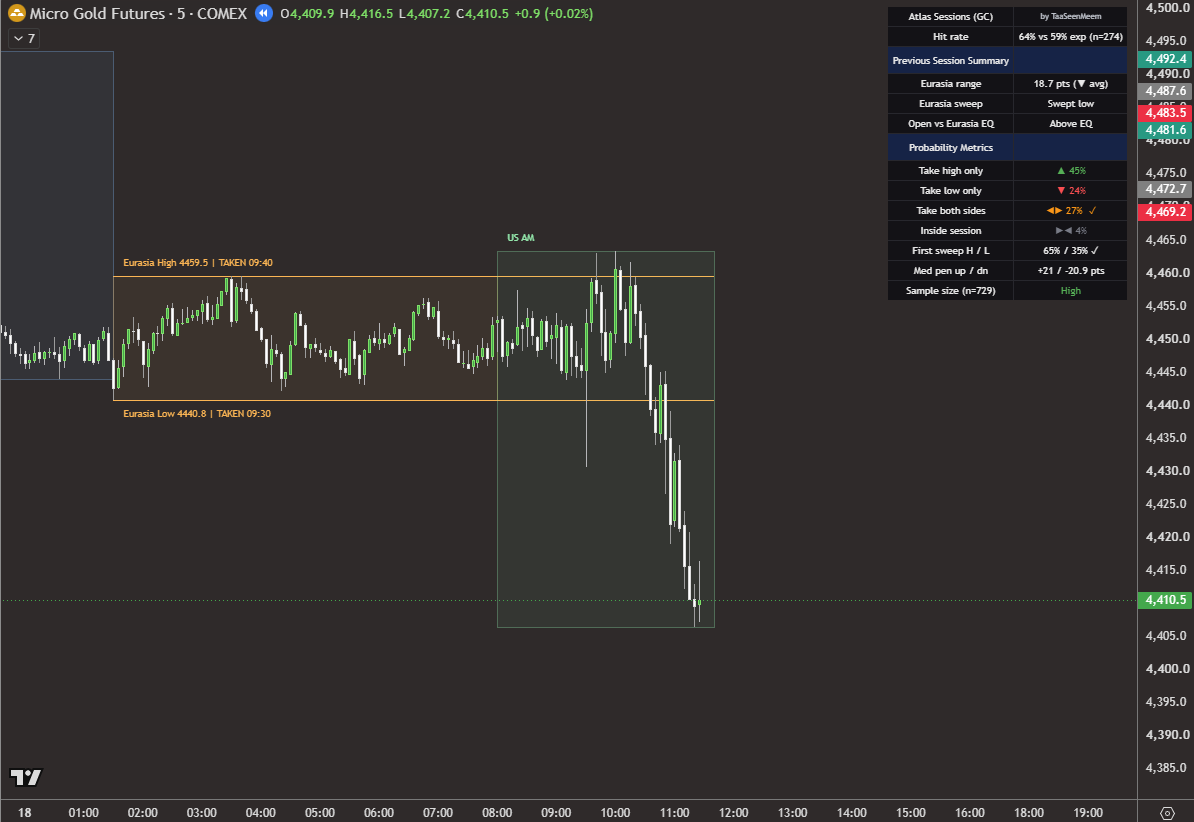
Low taken 09:30, high taken 09:40. Both sides, rated 27%, and the 65% high-first call went the other way.
An 18-point Eurasia, and the 09:30 candle took both levels ten minutes apart
First sweep ✗ · modal branch ✗ · both sides, rated 27%The narrowest prior session either gold week has produced, 18.7 points, which put both levels within ten points of the open. The tables leaned to the high anyway: 65% on it going first and 45% on high only. For ninety minutes nothing happened at all.
Then the 09:30 bar, the US equity open, dropped straight through the low and came back; the high went ten minutes later at 09:40 on the rebound, and the session then fell fifty points to 4407 by the close. First sweep wrong, branch wrong, and both marginals resolved as taken, 72% on the high and 51% on the low.
This is the week's double miss and it is worth stating plainly: a 65% call went the other way, on the tightest setup the record has seen. It is also a fair illustration of why a narrow prior session is a poor place to read direction from. When both levels are a few points away, which one a spike takes first is closer to a coin than the 65 suggests, and the per-side view, which only asks whether they go, is the one that held.
- Eurasia range18.7 pt, below average
- Prior sweepSwept low
- Open vs Eurasia EQAbove EQ
- Four-way45 / 24 / 27 / 4
- First sweep▲ 65% · ▼ 35%
- P(high taken)72% → taken 09:40
- P(low taken)51% → taken 09:30
- Samplen 729, High
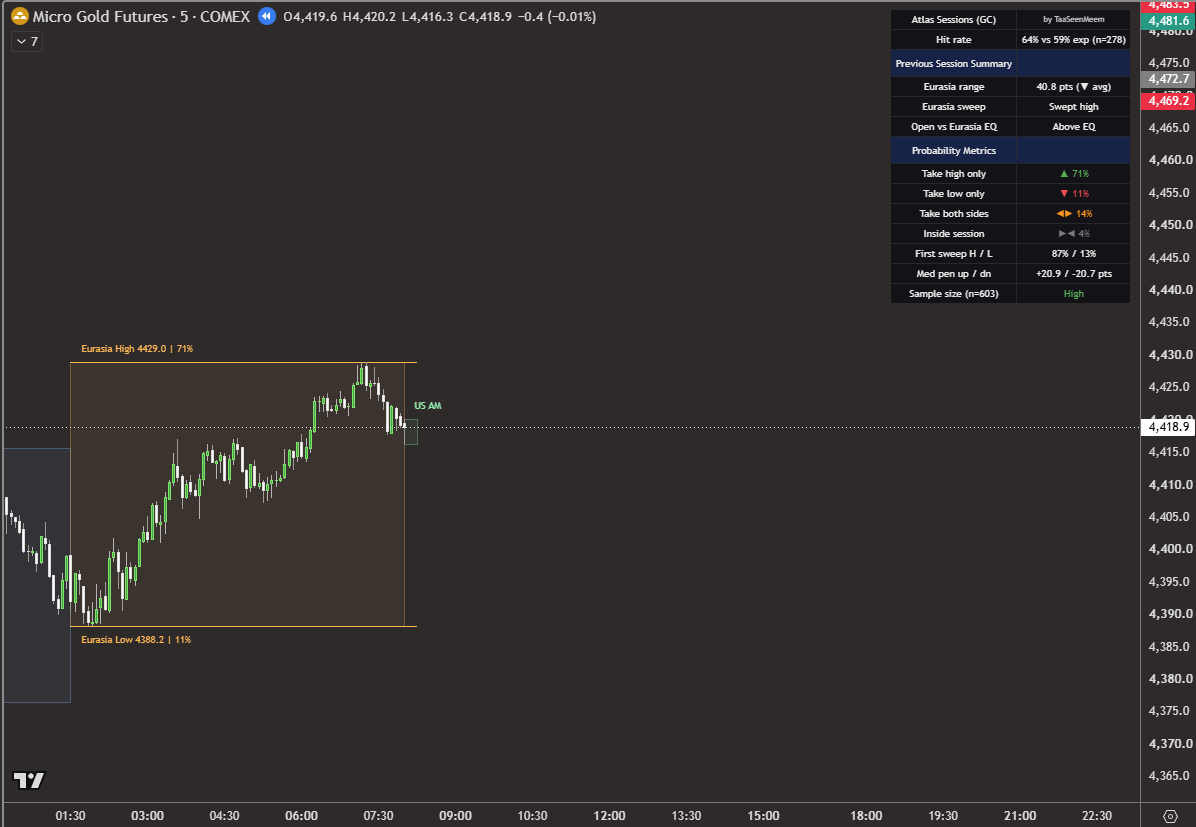
Eurasia high 4429.0 at 71%, low 4388.2 at 11%. Price above Eurasia EQ after Eurasia swept its own high. Tuesday 11 August's table, to the percentage point.
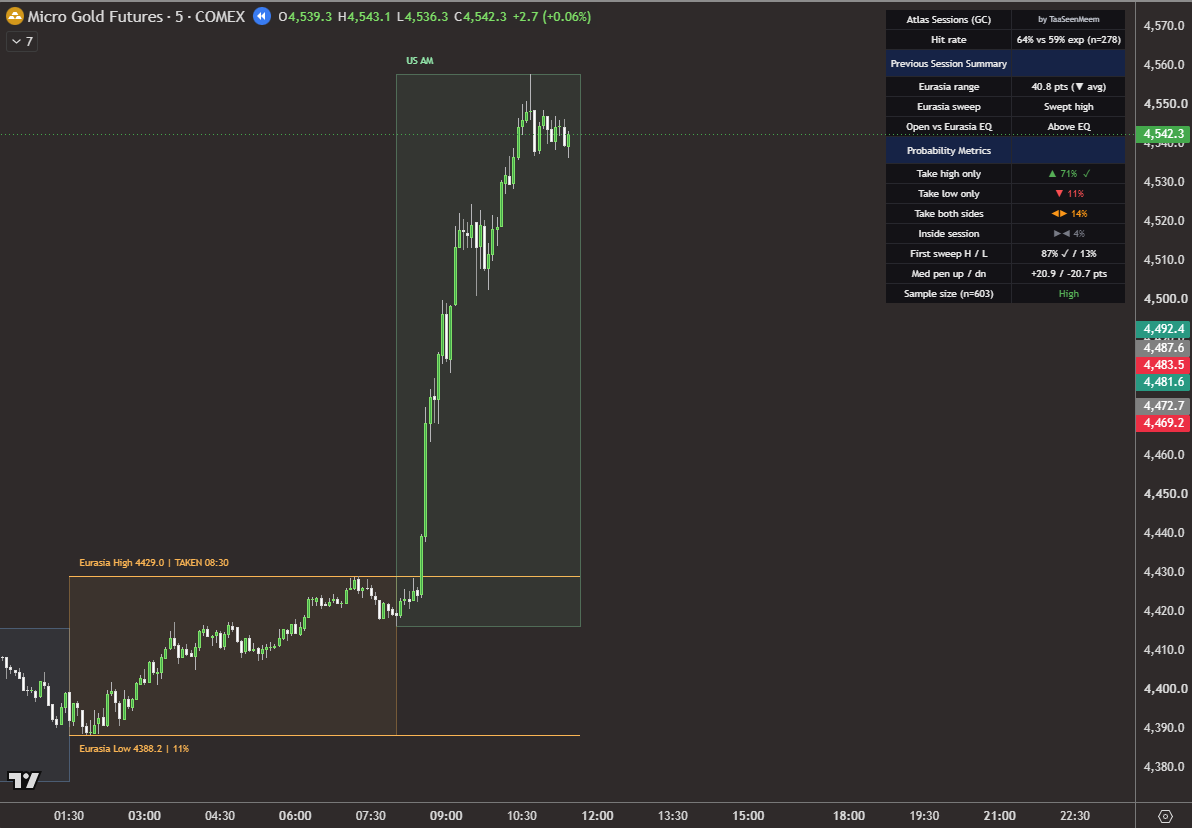
High taken 08:30, then a run of about 125 points. High only, the rated favourite at 71%.
The same cell as Tuesday 11 August, the same call, and a 125-point run behind it
First sweep ✓ · modal branch ✓ · high only, as rated🔴 FOMC minutes · 14:00 ET71 / 11 / 14 / 4, first sweep 87 / 13, out of 603 sessions: the table Tuesday 11 August drew, to the percentage point. That morning the high went at 08:05 and nothing else did. This morning the high went at 08:30 and nothing else did, and gold then ran about 125 points to 4555, the largest US AM move either gold week has shown.
The FOMC minutes printed at 14:00 ET, two and a half hours after the session closed, and had nothing to do with any of it. The day is marked because the calendar is marked on every page, not because the release touched the session.
Both marginals resolved as stated: the high at 85% went, the low at 25% did not. Two draws from one cell, two identical outcomes, which tells you exactly as little as the two-draws-two-outcomes cases elsewhere on these pages. What it does tell you is that the forecast is a lookup. Nothing about the 19th was used to produce the 19th's numbers.
- Eurasia range40.8 pt, below average
- Prior sweepSwept high
- Open vs Eurasia EQAbove EQ
- Four-way71 / 11 / 14 / 4
- First sweep▲ 87% · ▼ 13%
- P(high taken)85% → taken 08:30
- P(low taken)25% → not taken
- Samplen 603, High
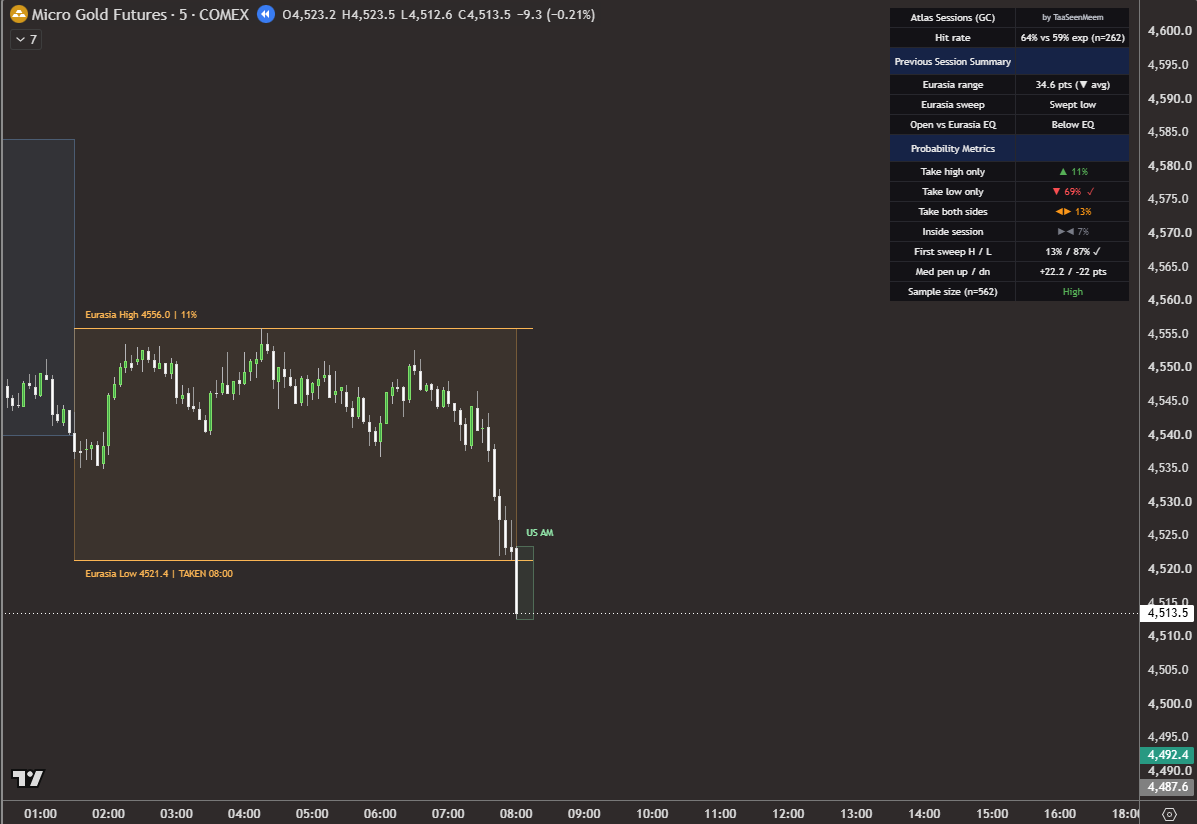
Eurasia low 4521.4, taken at 08:00 in the opening bar. High 4556.0 at 11%, thirty-five points away. Monday 10 August's table.
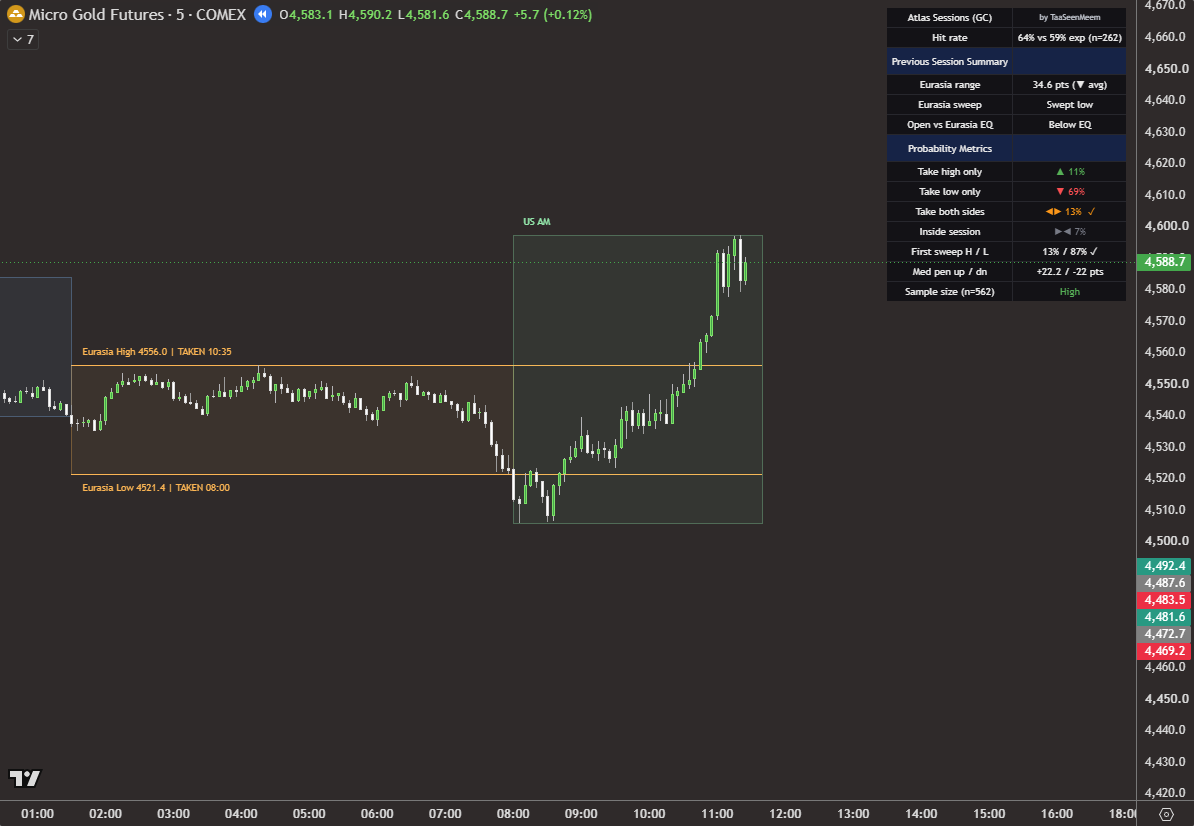
Low taken 08:00, high taken 10:35. Both sides, rated 13%; the 69% low-only favourite did not land.
Monday 10 August's cell, the low in the opening bar, and then the 24% high went too
First sweep ✓ · modal branch ✗ · both sides, rated 13%11 / 69 / 13 / 7 out of 562 sessions is the cell Monday 10 August drew, when the low went at 08:20 and the high was never approached. This time the low went in the opening bar, which is the easy half of the forecast, and the session then turned and climbed seventy-five points, through the high at 10:35.
Both sides at 13% is the second-smallest share on the table, and it landed. Low only at 69% was the favourite and did not. The first-sweep call survives intact at 87%, because it only asks which side goes first, and the low did.
Per side, one from two: the low at 82% went, as it should, and the high at 24% went, which is the part the tables did not expect. Same cell as the 10th, opposite branch, and the pair together is worth more than either alone: it is what a 69 / 13 split looks like when you get to see it twice.
- Eurasia range34.6 pt, below average
- Prior sweepSwept low
- Open vs Eurasia EQBelow EQ
- Four-way11 / 69 / 13 / 7
- First sweep▲ 13% · ▼ 87%
- P(high taken)24% → taken 10:35
- P(low taken)82% → taken 08:00
- Samplen 562, High
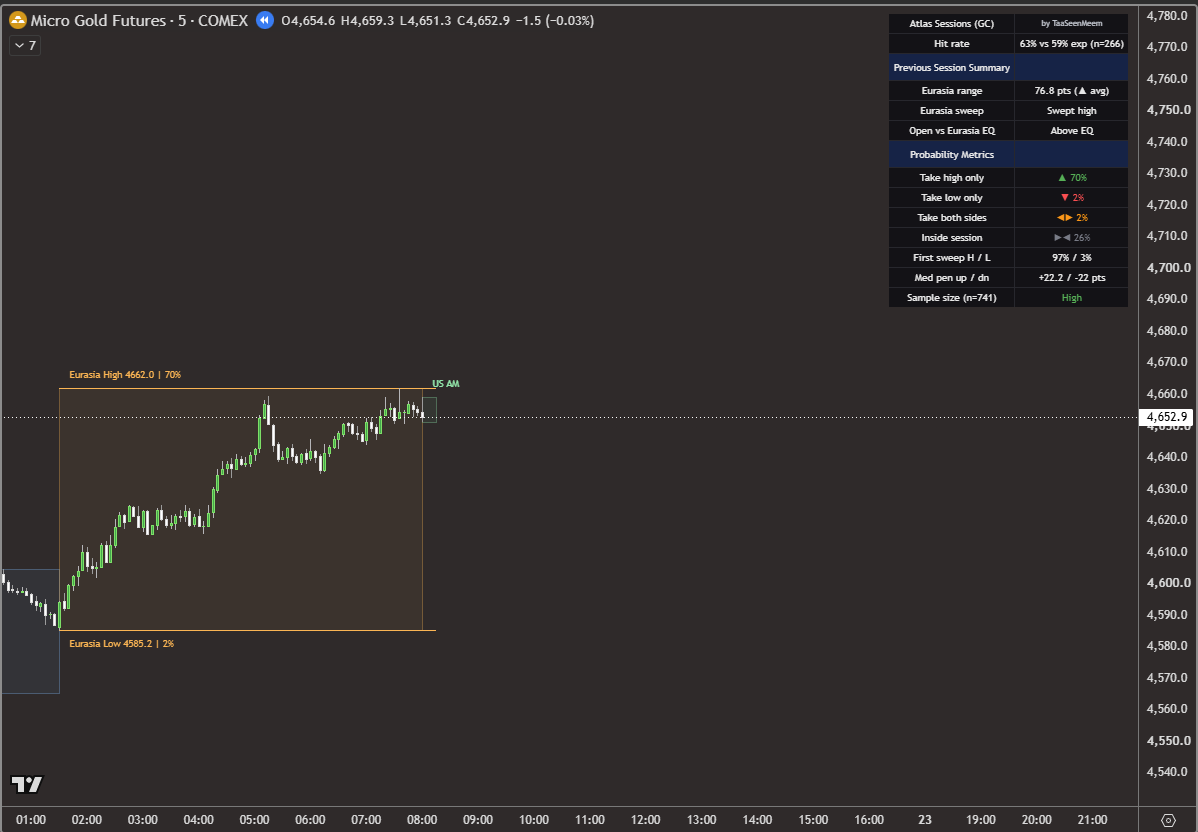
Eurasia high 4662.0 at 70%, low 4585.2 at 2%. Inside rated 26%, the highest the gold record has shown, on a 76.8 point Eurasia.
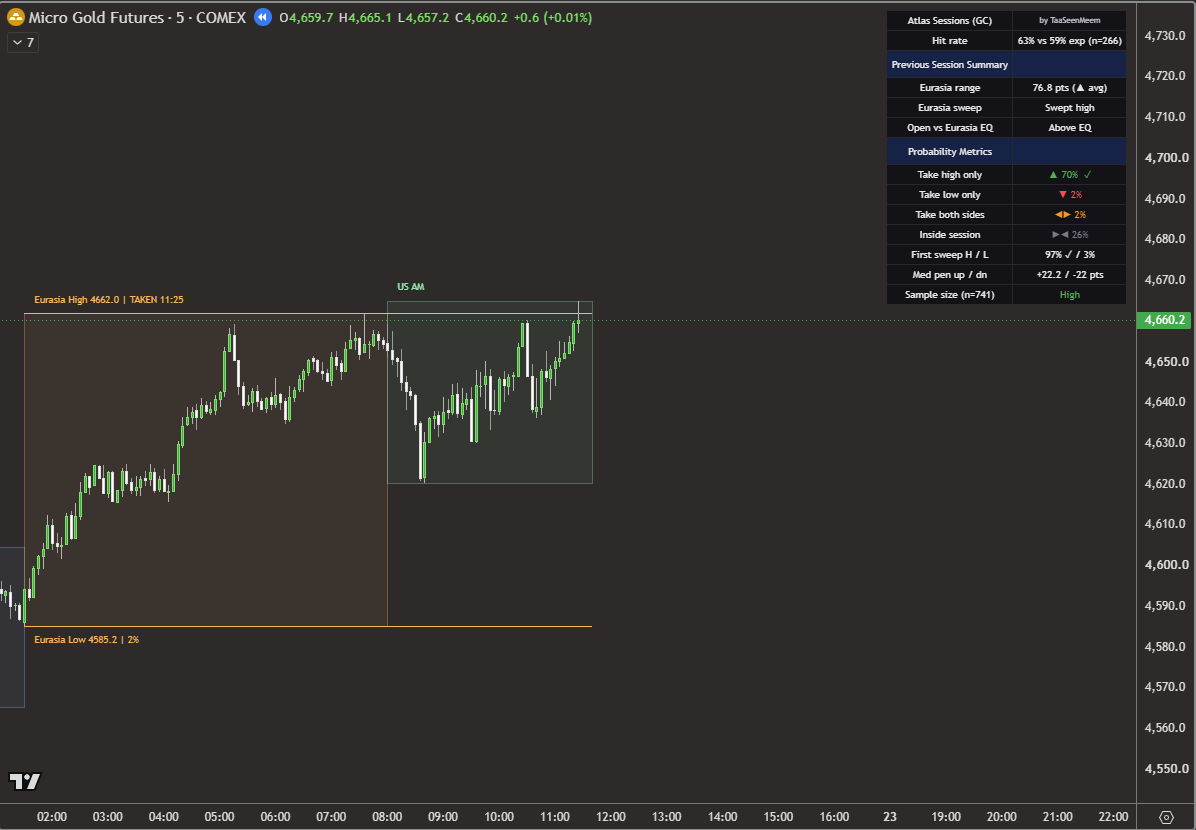
High taken 11:25, five minutes before the close. High only, the rated favourite at 70%; the 26% inside branch missed by five minutes.
A 97% call that took three and a half hours, and an inside session rated 26% that missed by five minutes
First sweep ✓ · modal branch ✓ · high only, as ratedThe widest Eurasia range either gold week has produced, 76.8 points, well above average. A wide prior session pushes both levels away and makes containment likelier, and the table said so: inside at 26%, the highest inside share the gold record has shown. Against that, the high sat nine points above the open with 97% on it going first.
The session spent three hours below the open, dipping to 4622 in the first hour and grinding back, and took the high at 11:25, five minutes before the close. Five more minutes inside and the 26% branch would have landed instead of the 70% one.
The most confident call of the week, and the one that came closest to not happening. Both marginals resolved as stated, the high at 72% taken and the low at 4% not, and the nine-point distance at the open is, as usual, most of the explanation for the 97.
- Eurasia range76.8 pt, above average
- Prior sweepSwept high
- Open vs Eurasia EQAbove EQ
- Four-way70 / 2 / 2 / 26
- First sweep▲ 97% · ▼ 3%
- P(high taken)72% → taken 11:25
- P(low taken)4% → not taken
- Samplen 741, High