The five NY AM sessions
Left, the session opening at 07:30. Right, the same chart at 11:30 with the outcome latched.
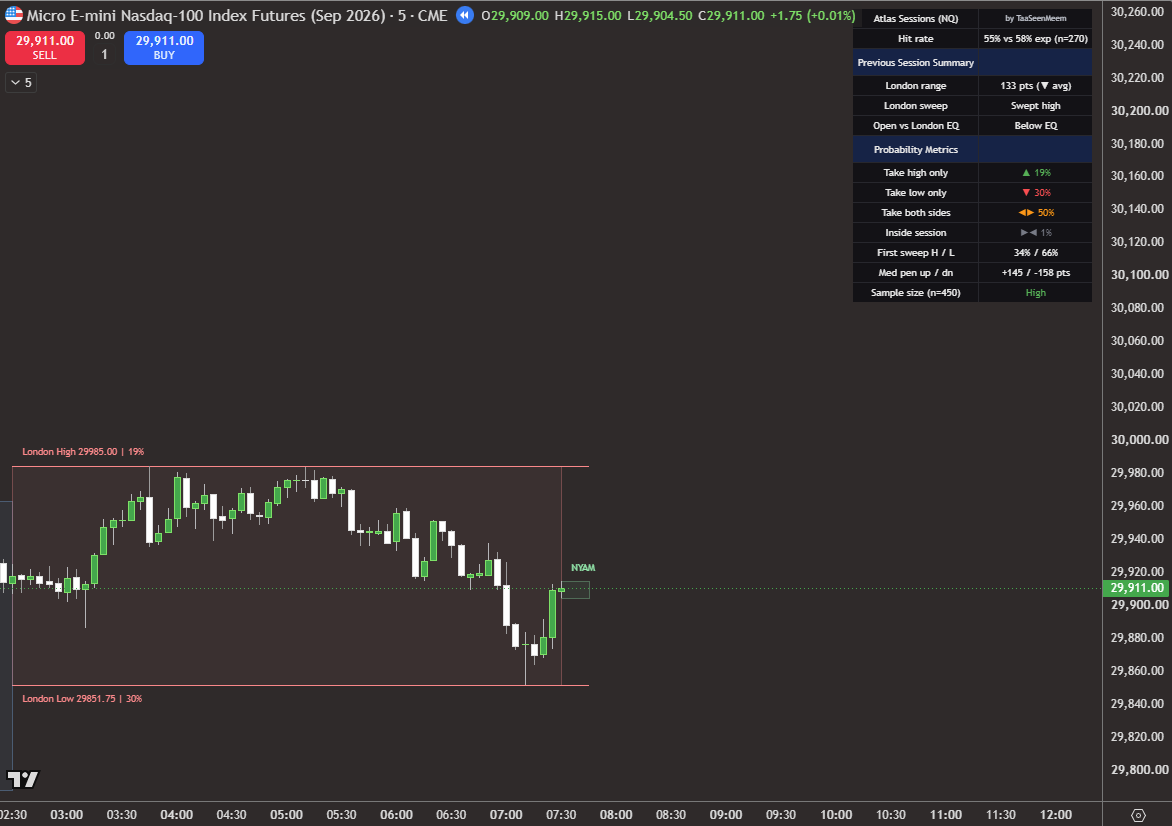
London high 29985.00 at 19%, low 29851.75 at 30%. Price below London EQ despite London having swept its own high.
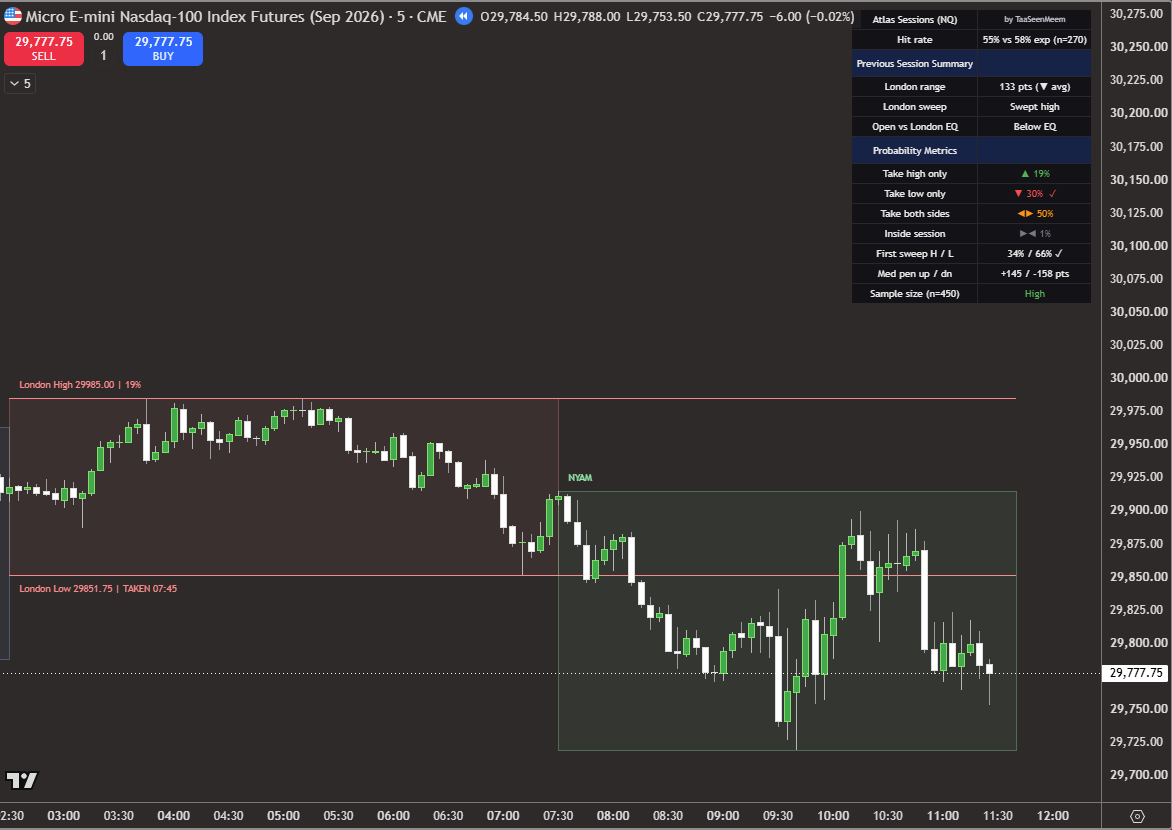
Low taken 07:45, high never approached. Low only, and the 50% favourite did not land.
The near side went, and nothing else did
First sweep ✓ · low only, against a 50% both-sides favouriteLondon swept its own high overnight and then handed NY AM a session that opened below London EQ, which puts the low nearer. The tables read that correctly: 66% on the low going first, and it went at 07:45.
After that the session did nothing useful. Price spent four hours ranging between the low it had just taken and the middle of London's range, never getting within a hundred points of the high. Both sides at 50% was the favourite and it did not land, so the session scores nothing on axis 2.
Axis 3 splits it one from two: the low at 80% was taken, the high at 69% was not. That 69% is the number to watch this week, because a version of it recurs on four of the five mornings.
- London range133 pt, below average
- Prior sweepSwept high
- Open vs London EQBelow EQ
- Four-way19 / 30 / 50 / 1
- First sweep▲ 34% · ▼ 66%
- P(high taken)69% → not taken
- P(low taken)80% → taken 07:45
- Samplen 450, High
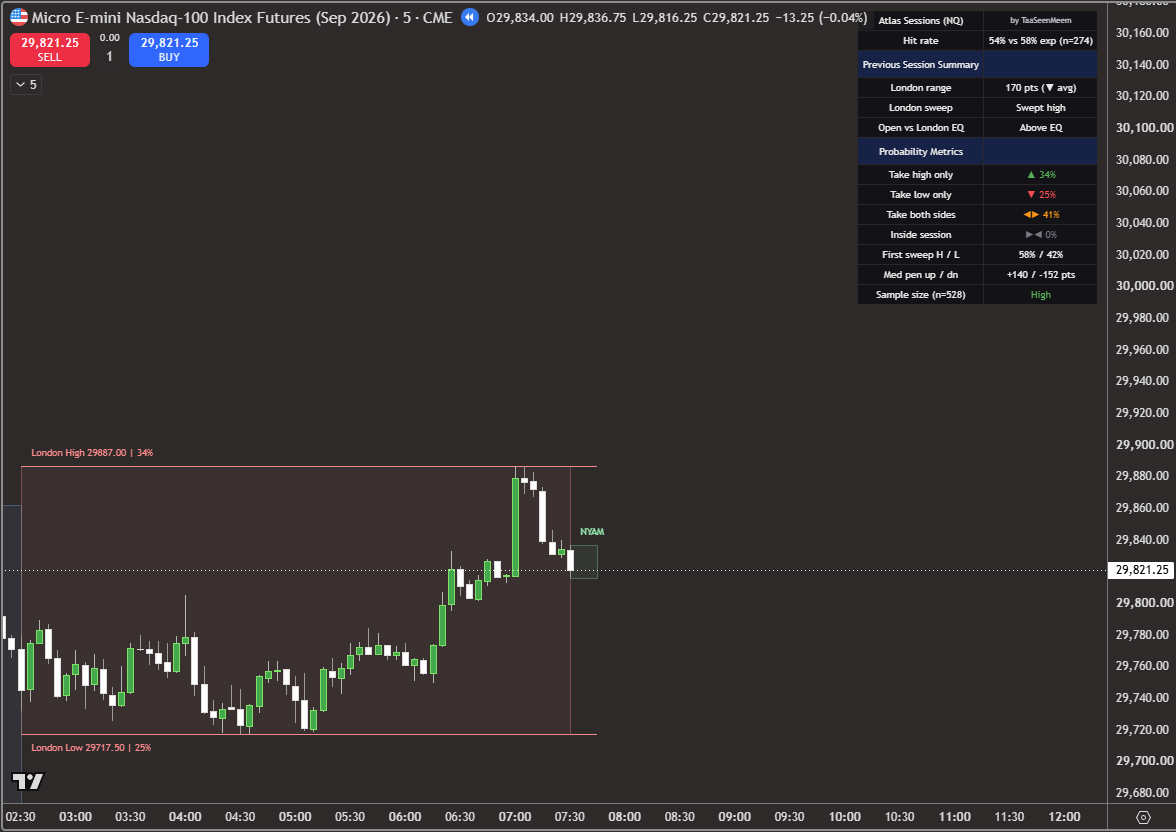
London high 29887.00 at 34%, low 29717.50 at 25%. Price above London EQ after London swept its high.
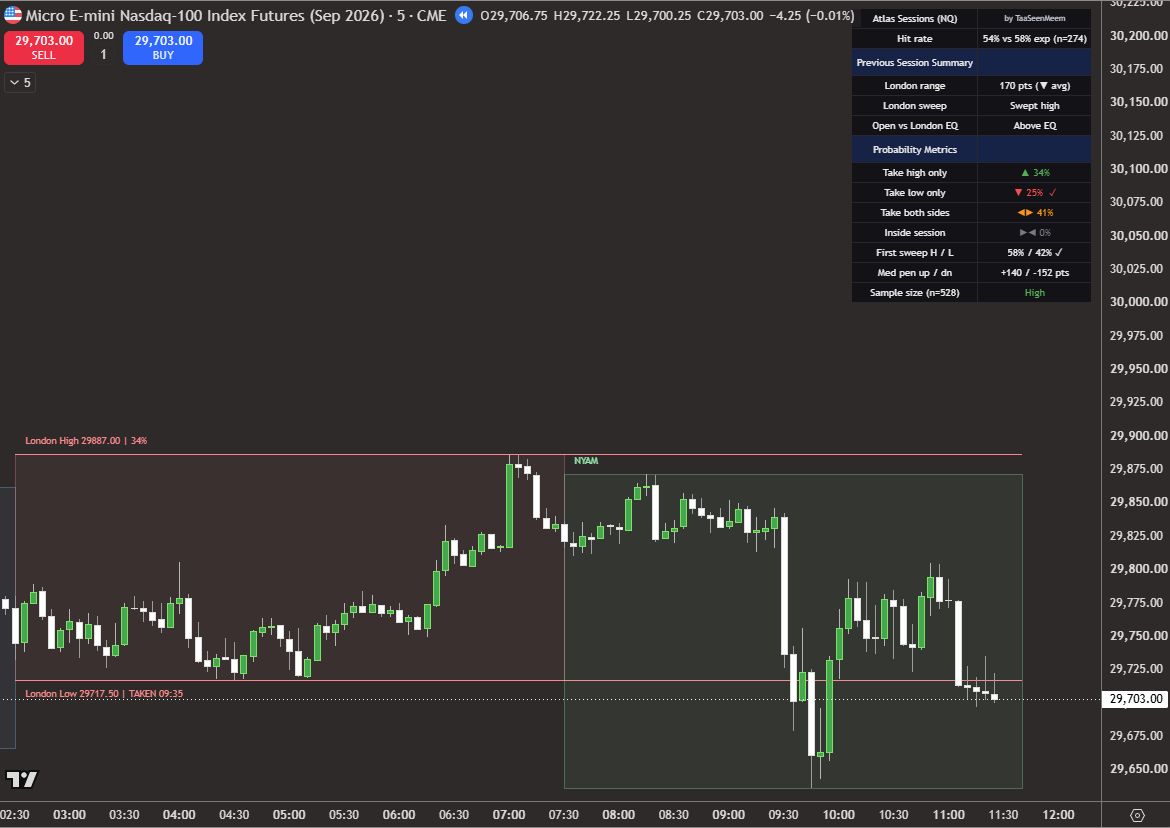
Low taken 09:35, high never reached. The 25% branch, the smallest on the table.
The worst session of the two weeks published so far
First sweep ✗ · low only, the 25% branchEverything the tables leaned on went the other way. The call was the high first at 58%; the low went first. The favourite was both sides at 41%; neither of the two most likely branches landed. What did land was low only at 25%, the smallest share on the table.
Price held above London EQ until the cash open, then dropped through the whole London range in under an hour, took the low at 09:35 and stayed down. The high, carrying a 75% marginal, was never threatened.
One from two on axis 3, zero on the other two axes. There is no reading of this session that flatters it, and a page that only published the good weeks would not be worth reading.
- London range170 pt, below average
- Prior sweepSwept high
- Open vs London EQAbove EQ
- Four-way34 / 25 / 41 / 0
- First sweep▲ 58% · ▼ 42%
- P(high taken)75% → not taken
- P(low taken)66% → taken 09:35
- Samplen 528, High
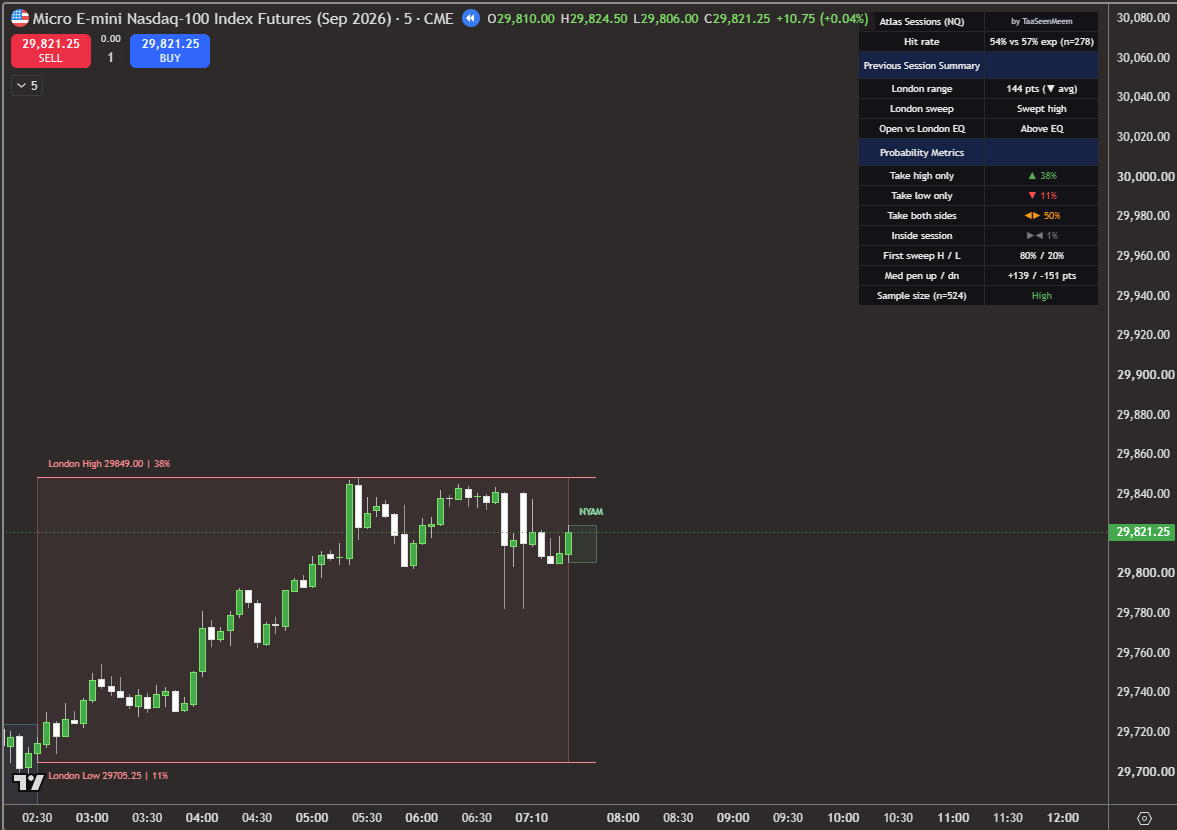
London high 29849.00 at 38%, low 29705.25 at 11%. Price pressed up against the high at the open.
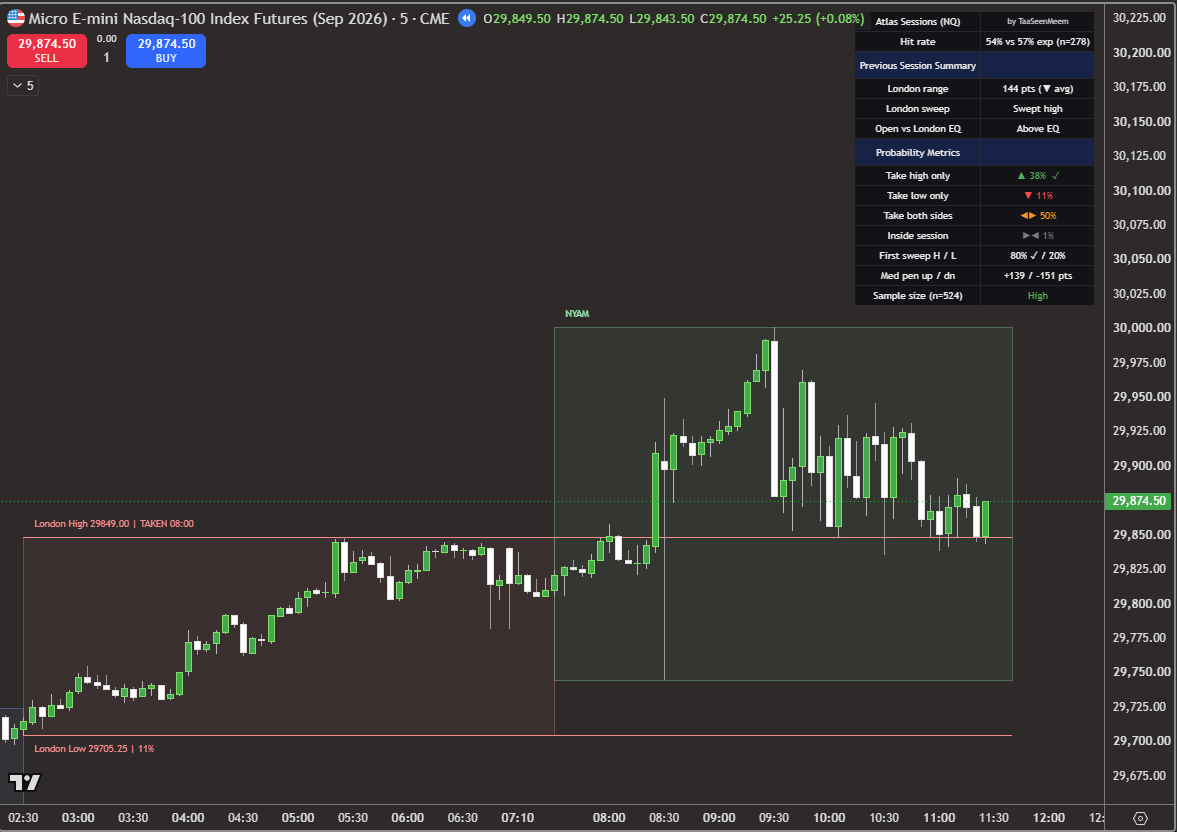
High taken 08:00, low never approached. High only, and the 50% favourite missed again.
The high went early, the low was never in the conversation
First sweep ✓ · high only, against a 50% both-sides favouritePrice opened right underneath London's high with an 80% call that it would go first, and it went at 08:00. From there the session ran roughly 150 points higher, faded through the late morning and closed near where it broke out.
The low, 144 points below the high and carrying a 61% marginal, was never within reach. So both sides at 50%, the favourite for the third morning running, missed for the third morning running.
This is also the first of the week's two identical forecasts. Hold the numbers in mind: 38 / 11 / 50 / 1 with first sweep 80 / 20. Friday returns exactly the same table and does something different with it.
- London range144 pt, below average
- Prior sweepSwept high
- Open vs London EQAbove EQ
- Four-way38 / 11 / 50 / 1
- First sweep▲ 80% · ▼ 20%
- P(high taken)88% → taken 08:00
- P(low taken)61% → not taken
- Samplen 524, High
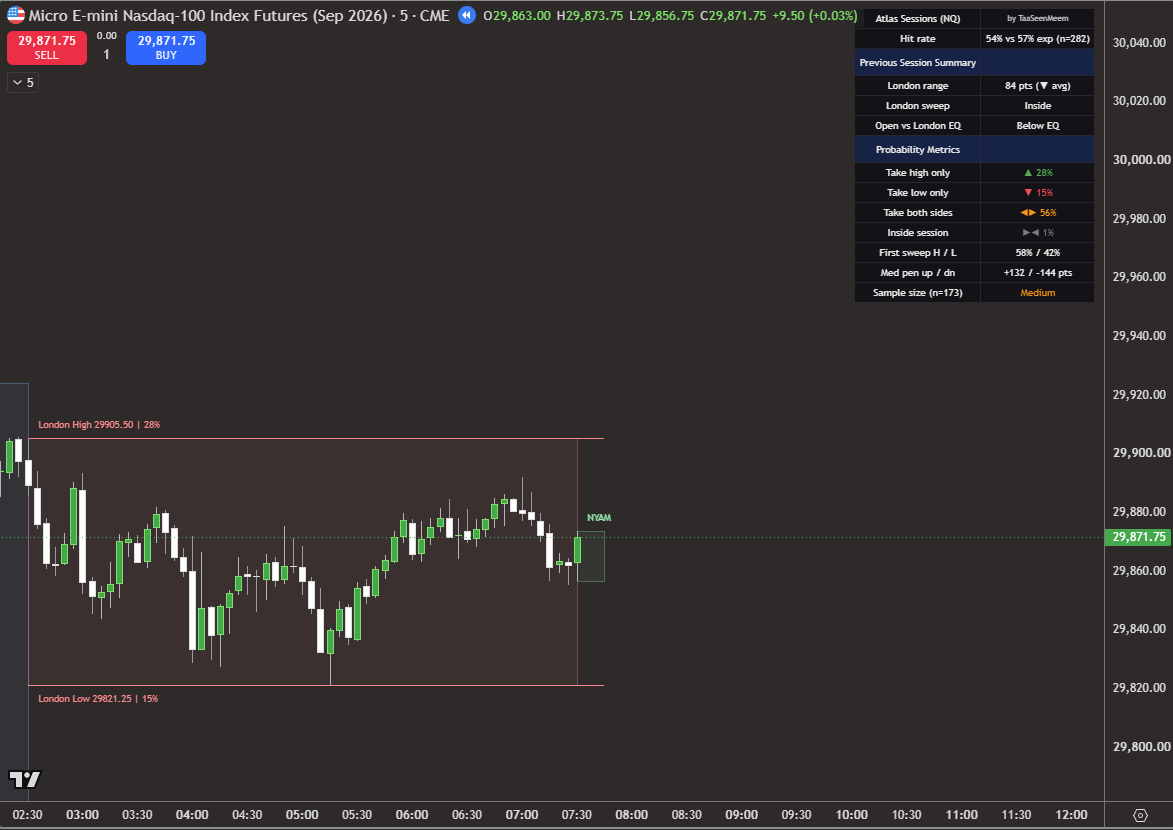
London high 29905.50 at 28%, low 29821.25 at 15%. An 84-point London, the tightest of either week, on the only Medium sample in twenty readings.
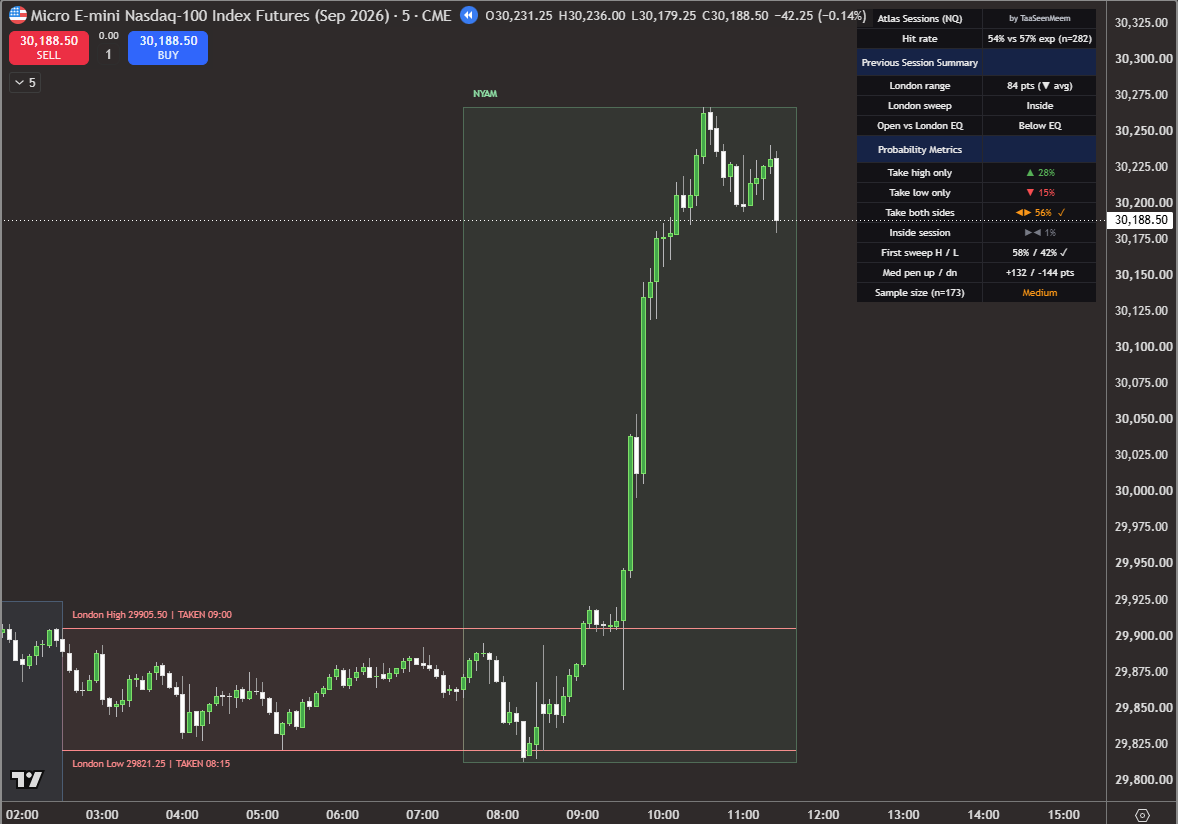
Low taken 08:15, high 09:00, then a run of roughly 450 points. Both sides, the favourite, landed.
A tiny prior session, and the strongest both-sides call of either week
First sweep ✗ · both sides, the 56% branch ✓London printed just 84 points, by some distance the tightest prior session across both weeks, and stayed inside its own predecessor's range. A pair of levels that close together is a pair that is hard to avoid, and the table said so with 56% on both sides, the highest both-sides share either week has produced.
It also produced the only Medium sample in twenty readings, n 173 against the 450 to 840 everywhere else. Fewer comparable sessions sit behind this forecast, and the indicator says so on its own face rather than hiding it.
Both levels went within 45 minutes, the low at 08:15 and the high at 09:00, and NY AM then ran roughly 450 points higher. The order was wrong, so axis 1 records a miss, but the branch and both sides were right.
- London range84 pt, below average
- Prior sweepInside
- Open vs London EQBelow EQ
- Four-way28 / 15 / 56 / 1
- First sweep▲ 58% · ▼ 42%
- P(high taken)84% → taken 09:00
- P(low taken)71% → taken 08:15
- Samplen 173, Medium
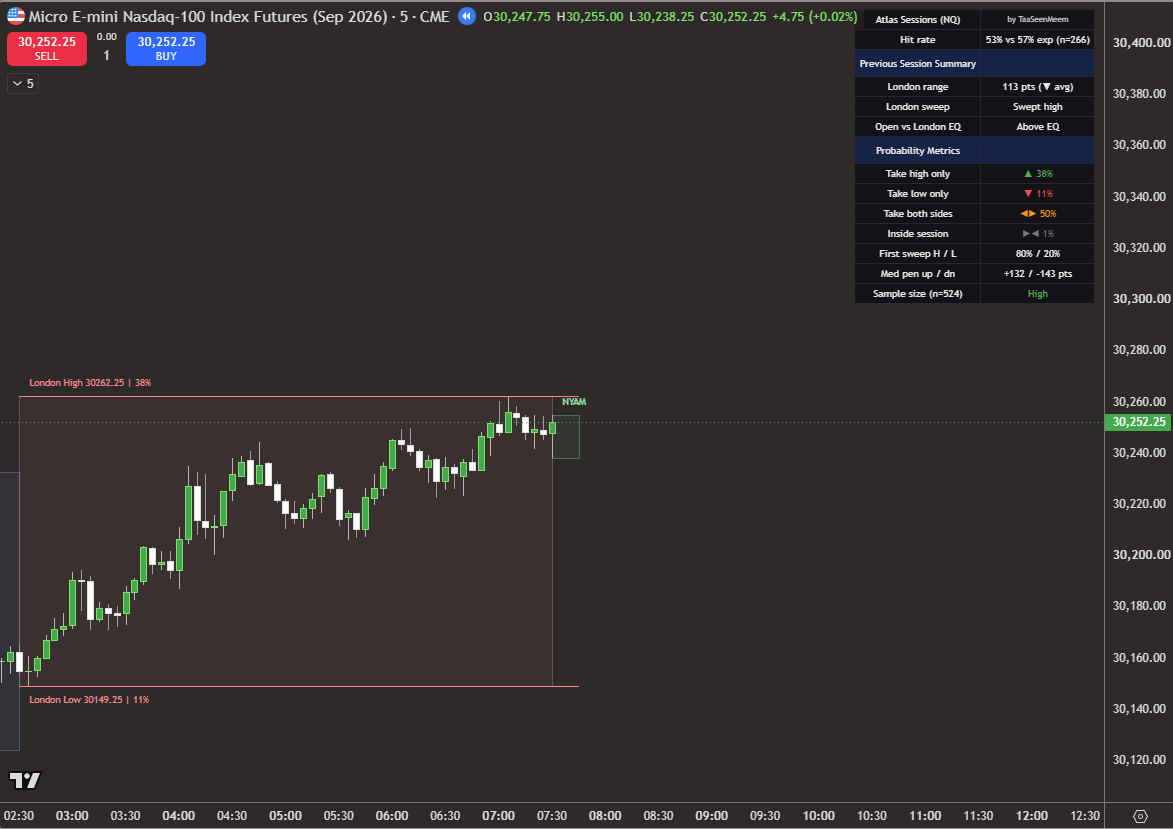
London high 30262.25 at 38%, low 30149.25 at 11%. The same table as Wednesday, to the percentage point.
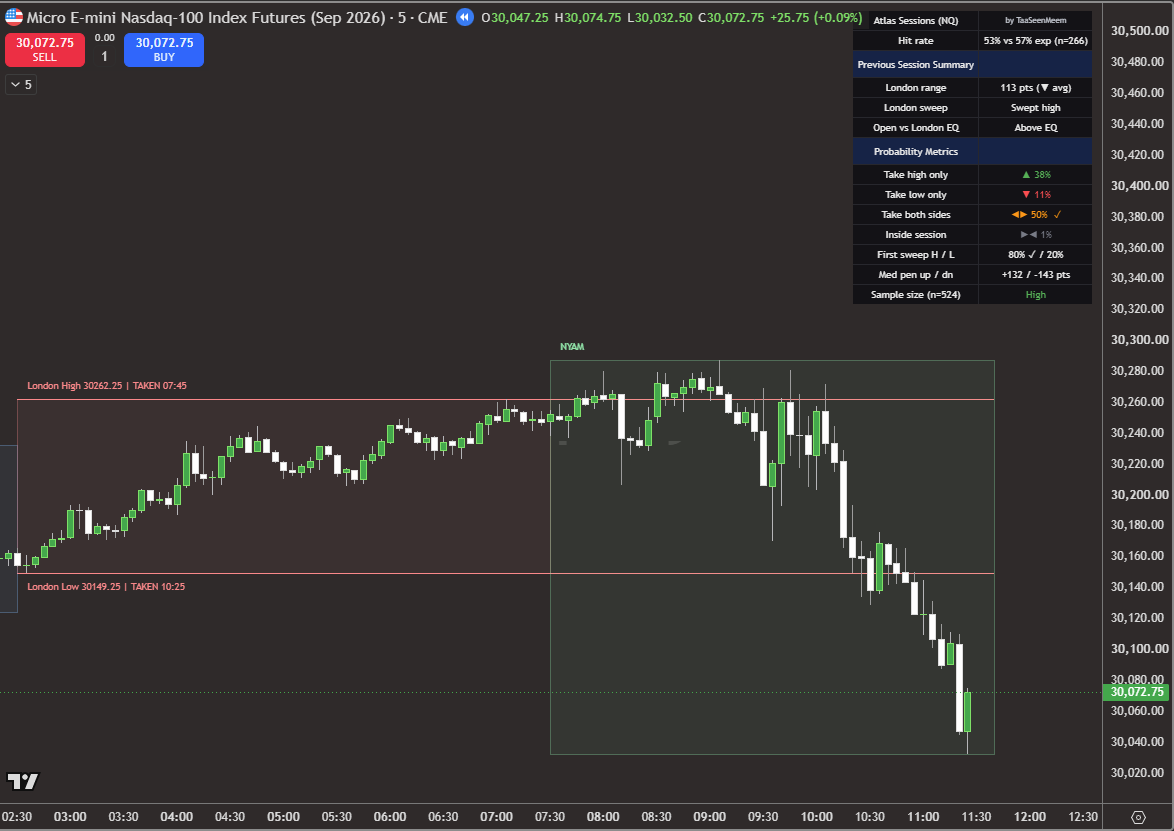
High taken 07:45, then a reversal took the low at 10:25. Both sides, from Wednesday's identical forecast.
The same forecast as Wednesday, and a different answer
First sweep ✓ · both sides, the 50% branch ✓Friday's table is identical to Wednesday's: 38 / 11 / 50 / 1, first sweep 80 / 20, sample n 524. Same context bin, same forecast, produced two days apart from a different London range.
The high went at 07:45, exactly as the 80% implied. Then, where Wednesday simply kept going, Friday reversed hard through the late morning, gave back the entire move and took the low at 10:25. Three from three on the day.
Two identical forecasts, one landing high only and the other both sides. That is not the model contradicting itself. That is what a 50% figure means, and it is the clearest illustration either week has produced.
- London range113 pt, below average
- Prior sweepSwept high
- Open vs London EQAbove EQ
- Four-way38 / 11 / 50 / 1
- First sweep▲ 80% · ▼ 20%
- P(high taken)88% → taken 07:45
- P(low taken)61% → taken 10:25
- Samplen 524, High