Sessions backtests → w/c 17 August 2026

NY AM, week commencing Monday 17 August 2026

Every one of this week's five forecasts was one the record had already seen, or saw twice. Two of the repeats resolved the same way as before and three did not, the both-sides favourite appeared once and lost, and the per-side view again carried the sessions the branch score buried. Three weeks in, the record is starting to show what the tables are.

At a glance

Three scores, because the indicator makes three separable claims.

3 / 5
first sweep called correctly, at a mean stated 71%
2 / 5
sessions that landed the four-way branch rated highest
7 / 10
levels taken, against a mean stated 67%
5 / 5
sessions whose forecast the record had already seen, or saw twice this week
SessionLondonPrior sweep High onlyLow onlyBothInside First sweep calledActualOutcome
Mon 17 Aug80 ptSwept high 28%15%56%1% ▲ high 58%▼ low 08:00 ✗low only
Tue 18 Aug210 ptSwept low 24%45%25%6% ▼ low 62%▼ low 08:35 ✓low only ✓
Wed 19 Aug FOMC min.182 ptSwept high 24%45%25%6% ▼ low 62%▲ high 08:35 ✗both sides
Thu 20 Aug265 ptSwept low 10%52%38%0% ▼ low 85%▼ low 07:30 ✓low only ✓
Fri 21 Aug161 ptSwept high 52%8%38%2% ▲ high 88%▲ high 07:35 ✓both sides

The four share columns are the indicator's own figures, read off the status table at the session open, and they sum to 100 on every row. Gold marks the branch the tables rated highest. London printed below its own average range on Monday, which made it eleven compressed prior sessions in a row across the record, and then above it on Tuesday and Thursday, ending the run. The only red folder USD release of the week was the FOMC minutes at 14:00 ET on Wednesday, two and a half hours after the session closed; it is marked against the day.

None of this week was in the sample. The Atlas Sessions tables were measured on NQ history ending 27 July 2026. Every session below happened afterwards, and the percentages are fixed lookups, so the figures shown are exactly what a live user saw at 07:30.
Every chart here is a 5-minute one, chosen for legibility and nothing else. The levels and the percentages are identical on any timeframe, because both are defined by clock time and price rather than by bars. Only the precision of the timestamp follows the bar size: a take stamped 08:35 here happened somewhere in the five minutes from 08:35.
The number on a level is an exclusive share, not the chance that level gets taken. London High | 28% means 28% of comparable sessions took the high and left the low alone. The chance the high is taken at all is high only plus both sides, which on Monday was 28 + 56 = 84%. The full explanation is on the first week's page.
Session by session

The five NY AM sessions

Left, the session opening at 07:30. Right, the same chart at 11:30 with the outcome latched.
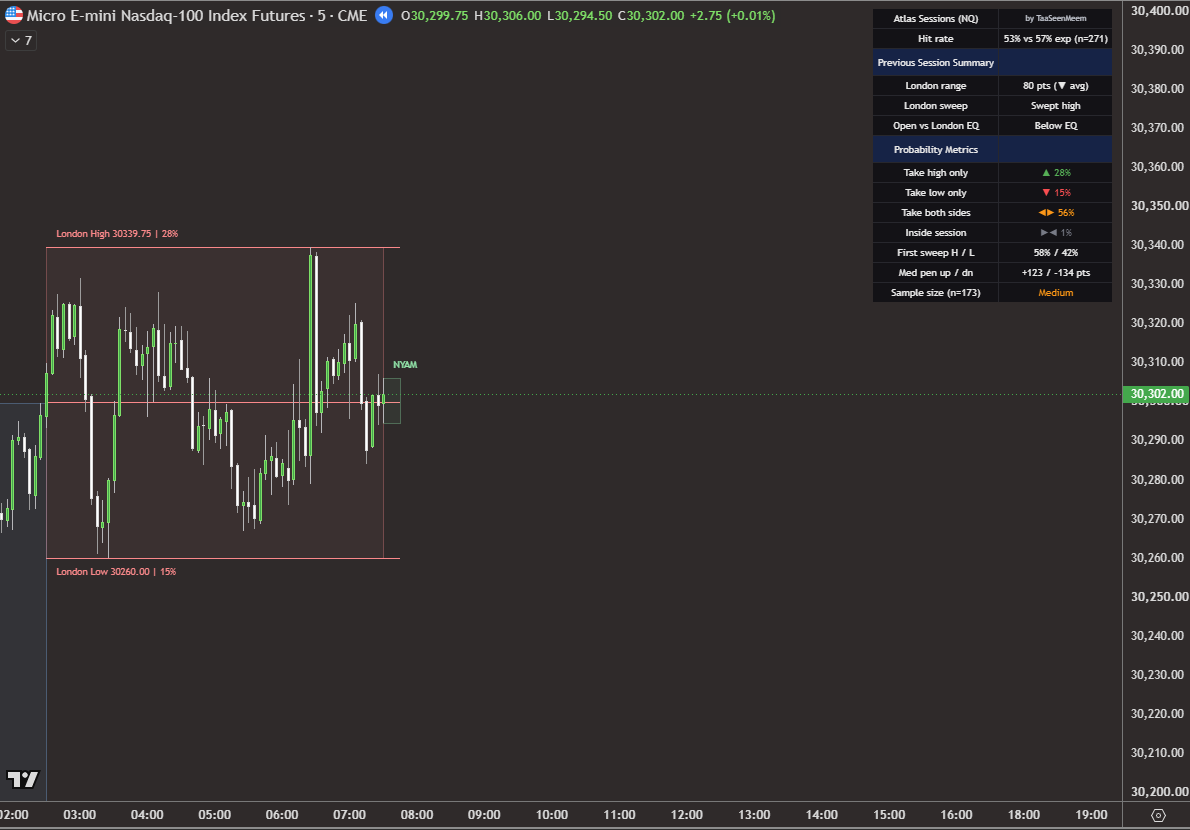
Monday 17 August 2026, NY AM opening at 07:30 on NQ: an 80 point London range, the tightest of the three weeks published, the high at 28 percent and the low at 15 percent with price just below London EQ, both sides rated 56 percent and the first sweep 58 to 42 favouring the high.
07:30 open
London high 30339.75 at 28%, low 30260.00 at 15%. An 80-point London, the tightest prior session of the record, on the Medium sample that last appeared on Thursday 13 August.
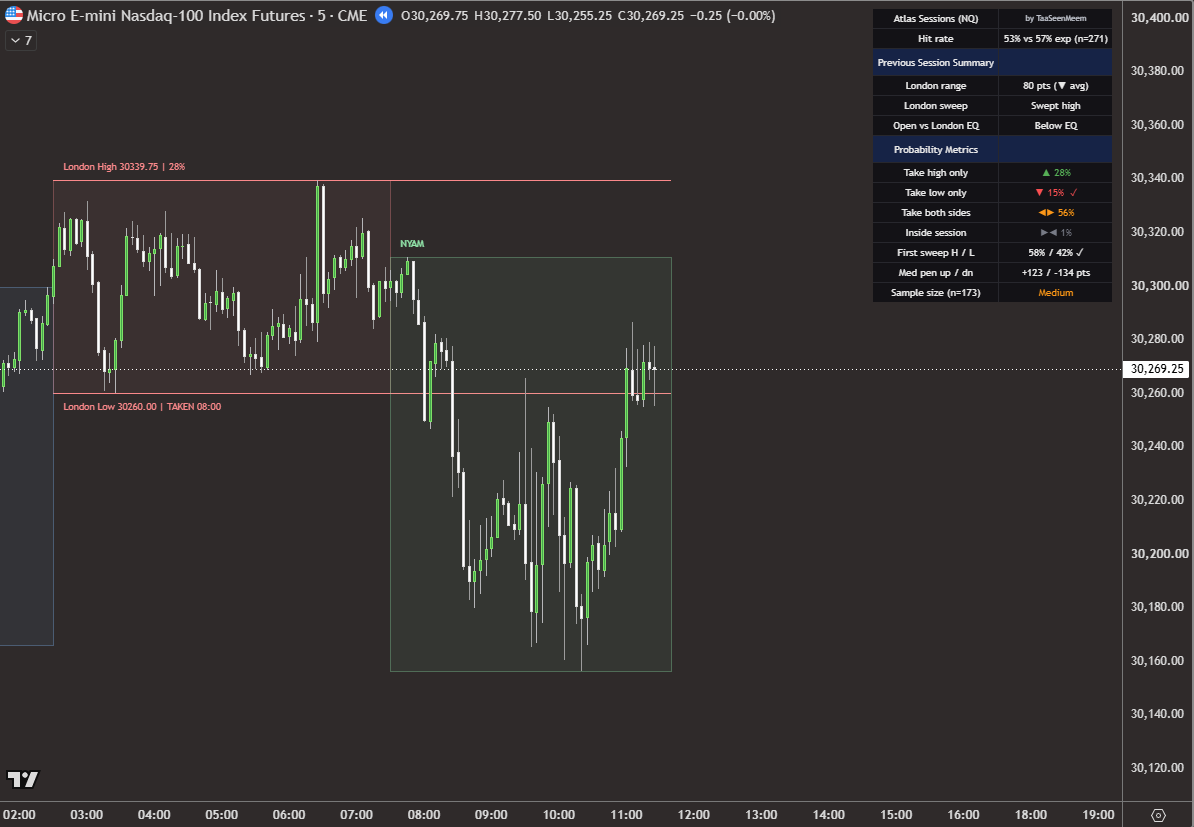
Monday 17 August 2026, NY AM at the close: the London low latched taken at 08:00, price falling about 100 points further to 30160 by mid-morning and recovering to the middle of London's range, the high never approached.
11:30 close
Low taken 08:00, high never approached. Low only, the 15% branch; the 56% both-sides favourite did not land.
Monday 17 August

The week's strongest both-sides call, and the session took one side and stopped

First sweep ✗ · low only, the 15% branch, against a 56% both-sides favourite

London printed 80 points, below average and the tightest prior session of the three weeks published so far, and the tables answered the way they did on Thursday 13 August, which is the same bin: 56% on both sides, the strongest both-sides call of the record, on a sample of 173 marked Medium.

The low went at 08:00, half an hour in, and price fell a further hundred points before turning. The recovery got as far as the middle of London's range and no further. The high, eighty points above the low and carrying an 84% marginal, was never approached, so the session closed low only, a branch the table rated at 15%.

Two misses and one from two. The first-sweep call was the high at 58% and the low went; the branch was both sides and one side went. Thursday the 13th drew this same table and took both levels inside forty-five minutes. Same lookup, opposite branch, which is the week's theme and the section after the charts is about it.

  • London range80 pt, below average
  • Prior sweepSwept high
  • Open vs London EQBelow EQ
  • Four-way28 / 15 / 56 / 1
  • First sweep▲ 58% · ▼ 42%
  • P(high taken)84% → not taken
  • P(low taken)71% → taken 08:00
  • Samplen 173, Medium
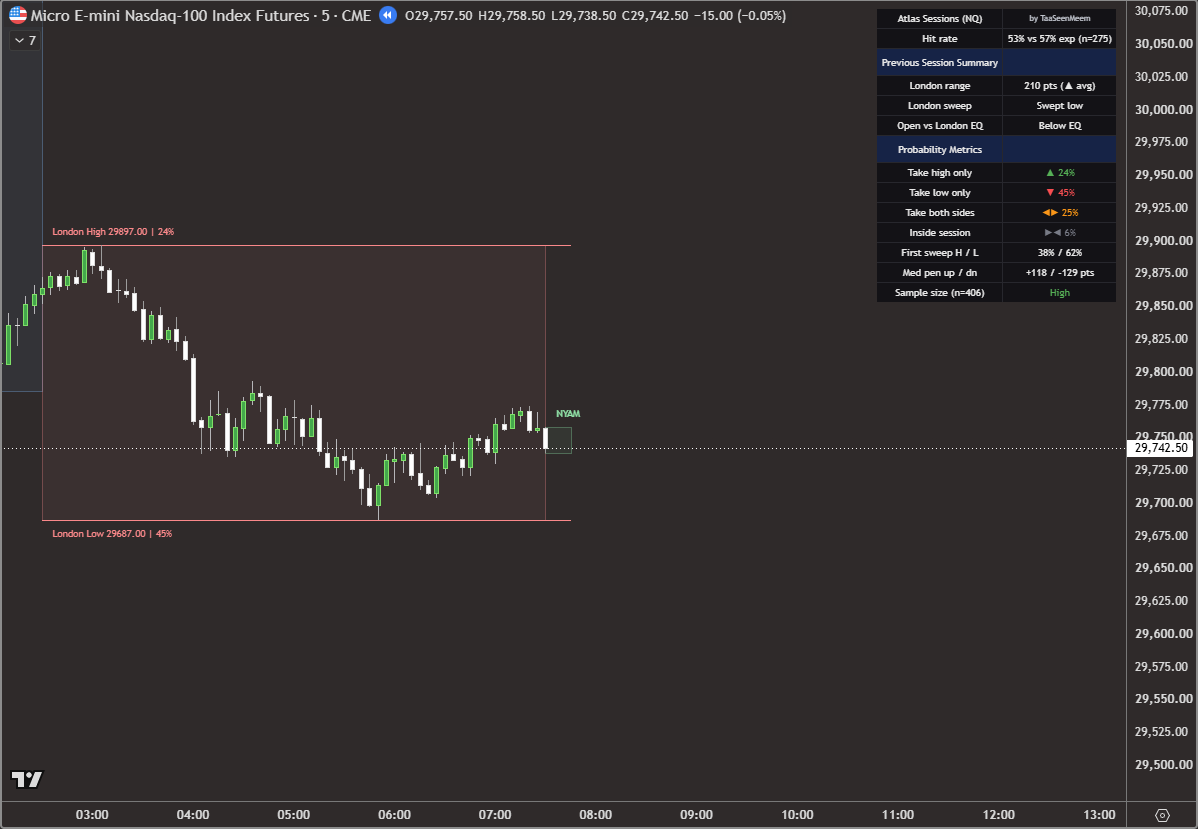
Tuesday 18 August 2026, NY AM opening at 07:30 on NQ: a 210 point London range, above average for the first time in eleven sessions, the high at 24 percent and the low at 45 percent with price below London EQ, first sweep 38 to 62 favouring the low.
07:30 open
London high 29897.00 at 24%, low 29687.00 at 45%. Price below London EQ after London swept its own low. The first above-average London in eleven sessions.
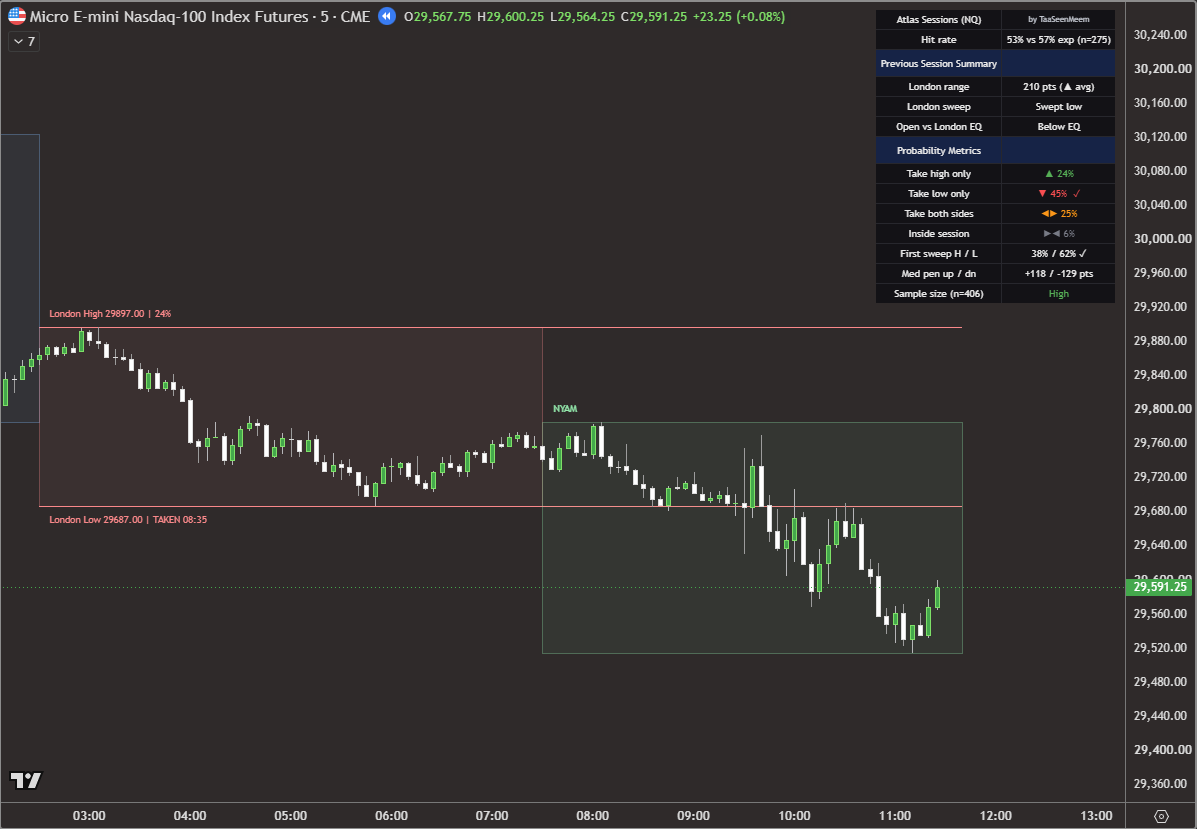
Tuesday 18 August 2026, NY AM at the close: the London low latched taken at 08:35 and price grinding lower through the rest of the morning to 29520, the high 210 points above never approached.
11:30 close
Low taken 08:35, high never reached. Low only, the rated favourite at 45%.
Tuesday 18 August

A wide London, a near low, and the favourite landed cleanly

First sweep ✓ · low only, the 45% favourite ✓

The first London to print above its own average range in eleven sessions, 210 points, and the tables put the low nearer: price opened below EQ, 62% on the low going first, 45% on low only. The low went at 08:35 and the session then ground lower for the rest of the morning, never getting within a hundred and fifty points of the high.

Three from three on the day: first sweep, branch, and both marginals, the low at 70% taken and the high at 49% not. A clean morning, and worth holding the table in mind, because Wednesday returns exactly the same one.

  • London range210 pt, above average
  • Prior sweepSwept low
  • Open vs London EQBelow EQ
  • Four-way24 / 45 / 25 / 6
  • First sweep▲ 38% · ▼ 62%
  • P(high taken)49% → not taken
  • P(low taken)70% → taken 08:35
  • Samplen 406, High
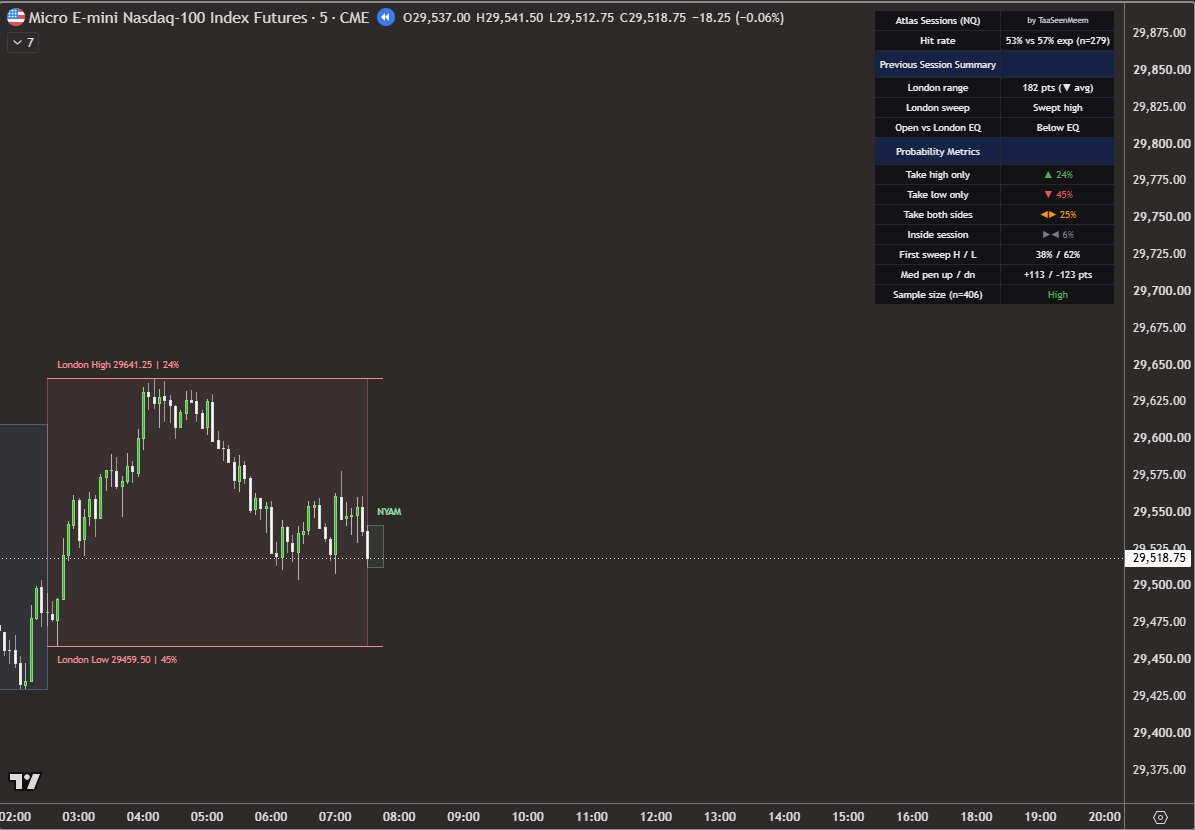
Wednesday 19 August 2026, NY AM opening at 07:30 on NQ: a 182 point London range, the high at 24 percent and the low at 45 percent with price below London EQ, the same table as Tuesday to the percentage point, first sweep 38 to 62 favouring the low.
07:30 open
London high 29641.25 at 24%, low 29459.50 at 45%. Tuesday's table, to the percentage point, from a different London range.
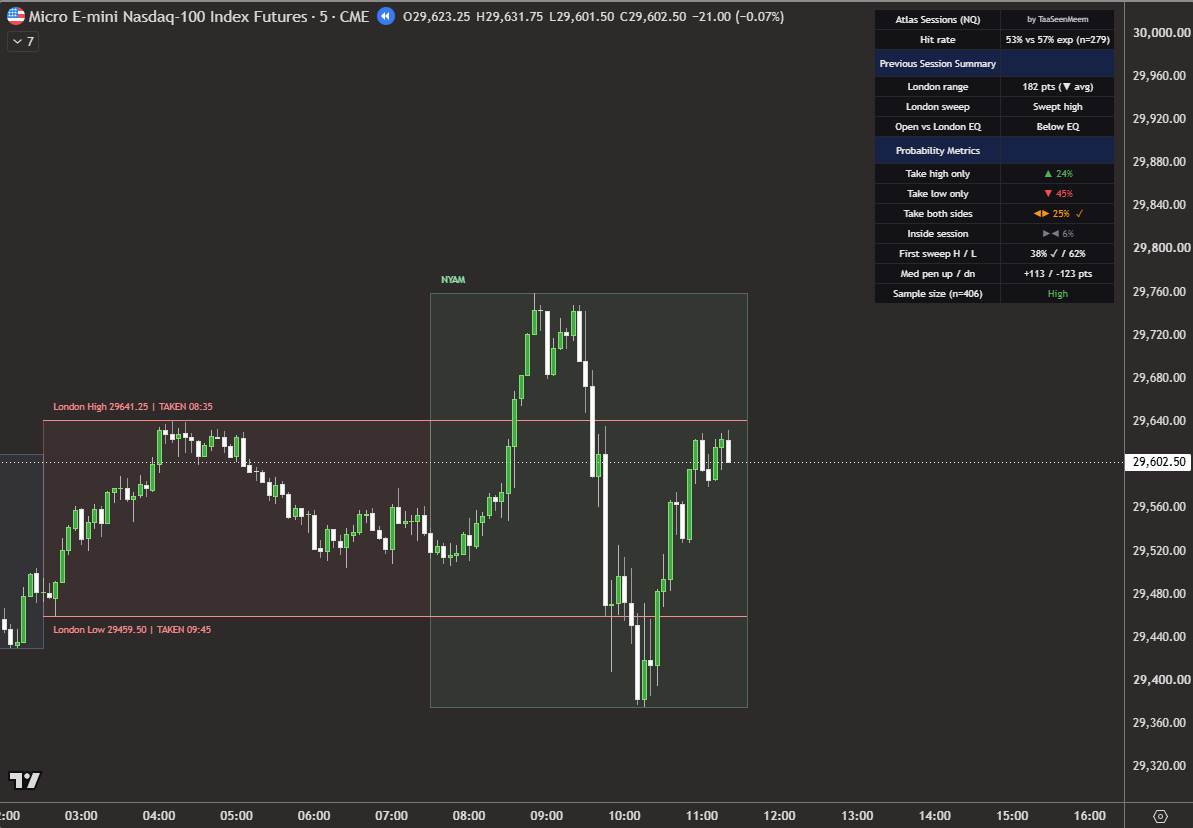
Wednesday 19 August 2026, NY AM at the close: the London high latched taken at 08:35 after a 100 point rally, then a 350 point reversal through the whole London range taking the low at 09:45, and a recovery into the close. Both levels taken.
11:30 close
High taken 08:35, low taken 09:45. Both sides, the 25% branch, from Tuesday's identical forecast.
Wednesday 19 August

Tuesday's forecast again, and the session did the other thing

First sweep ✗ · both sides, the 25% branch🔴 FOMC minutes · 14:00 ET

24 / 45 / 25 / 6, first sweep 38 / 62, n 406: Tuesday's table exactly, drawn from a London that was 28 points narrower and below average where Tuesday's was above. Same bin, same lookup, same numbers.

Tuesday took the low and stopped. Wednesday rallied a hundred points off the open, took the high at 08:35, then reversed 350 points through the whole London range, took the low at 09:45, and recovered into the close. Both sides, the 25% branch, with the first sweep on the side the tables rated at 38.

The FOMC minutes at 14:00 ET came two and a half hours after the session closed and had nothing to do with any of it; the day is marked because the calendar is marked on every page. The per-side view scores two from two, both marginals resolving taken. The other two axes score nothing, and the pair of mornings together is the most useful thing on the page.

  • London range182 pt, below average
  • Prior sweepSwept high
  • Open vs London EQBelow EQ
  • Four-way24 / 45 / 25 / 6
  • First sweep▲ 38% · ▼ 62%
  • P(high taken)49% → taken 08:35
  • P(low taken)70% → taken 09:45
  • Samplen 406, High
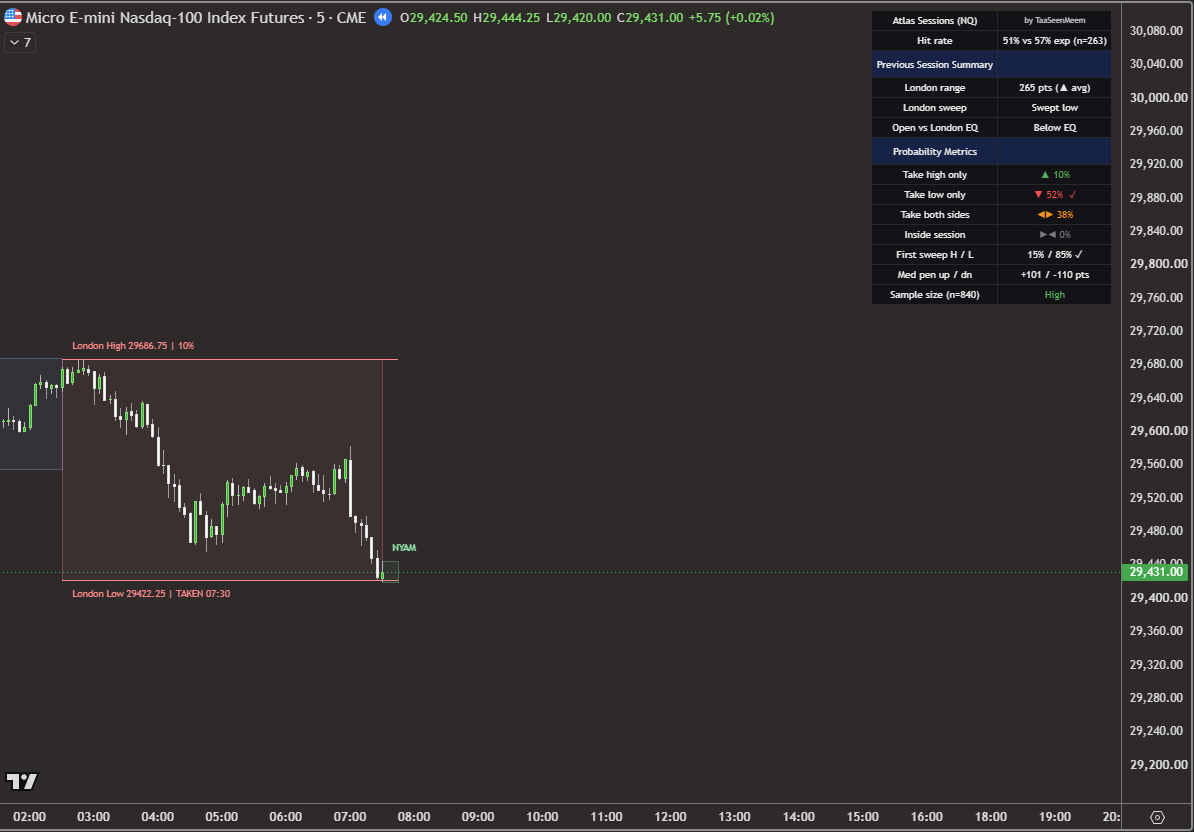
Thursday 20 August 2026, NY AM opening at 07:30 on NQ: a 265 point London range, the widest of the record, price opening right on the London low which is already latched taken at 07:30, the high 265 points above at 10 percent, first sweep 15 to 85 favouring the low.
07:30 open
London low 29422.25, taken at 07:30 in the opening bar. High 29686.75 at 10%, 265 points away. Monday 3 August's table.
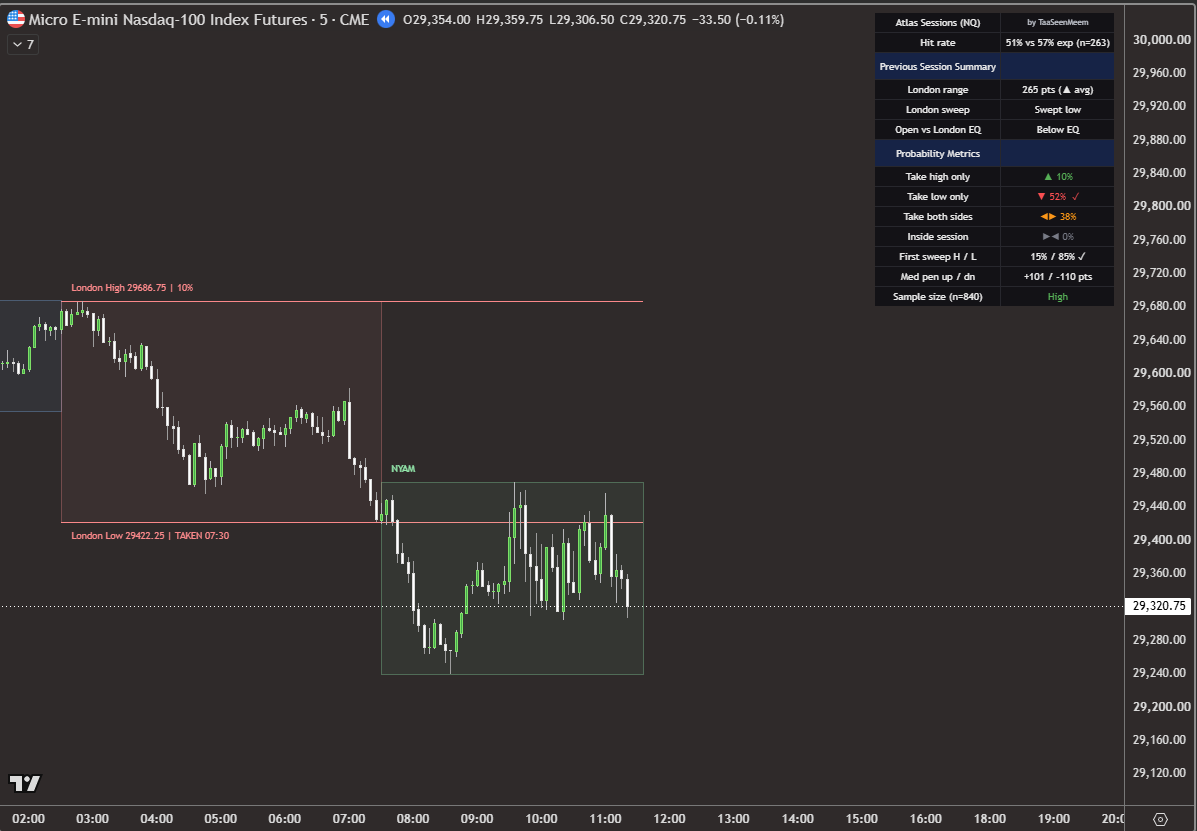
Thursday 20 August 2026, NY AM at the close: the low taken at 07:30, price dipping a further 160 points before recovering to range just above the low for the rest of the morning, the high never approached.
11:30 close
Low taken 07:30, high never approached. Low only, the rated favourite at 52%.
Thursday 20 August

The low went in the opening bar, and the call was close to arithmetic

First sweep ✓ · low only, the 52% favourite ✓

The widest London of the record at 265 points, and a session that opened sitting on London's low. The tables put 85% on the low going first and 52% on low only, and the low went in the opening bar. The high, 265 points away at a 48% marginal, was never a live question.

This is Monday 3 August's bin, 10 / 52 / 38 / 0 from 840 sessions. That morning the low went at 07:35 and the high followed at 10:20, both sides; this one took the low and stayed down. Two from two on the marginals here, the 90% low taken and the 48% high not, and a first-sweep call that was, as on most mornings where a level is within touching distance at the open, closer to arithmetic than to insight.

  • London range265 pt, above average
  • Prior sweepSwept low
  • Open vs London EQBelow EQ
  • Four-way10 / 52 / 38 / 0
  • First sweep▲ 15% · ▼ 85%
  • P(high taken)48% → not taken
  • P(low taken)90% → taken 07:30
  • Samplen 840, High
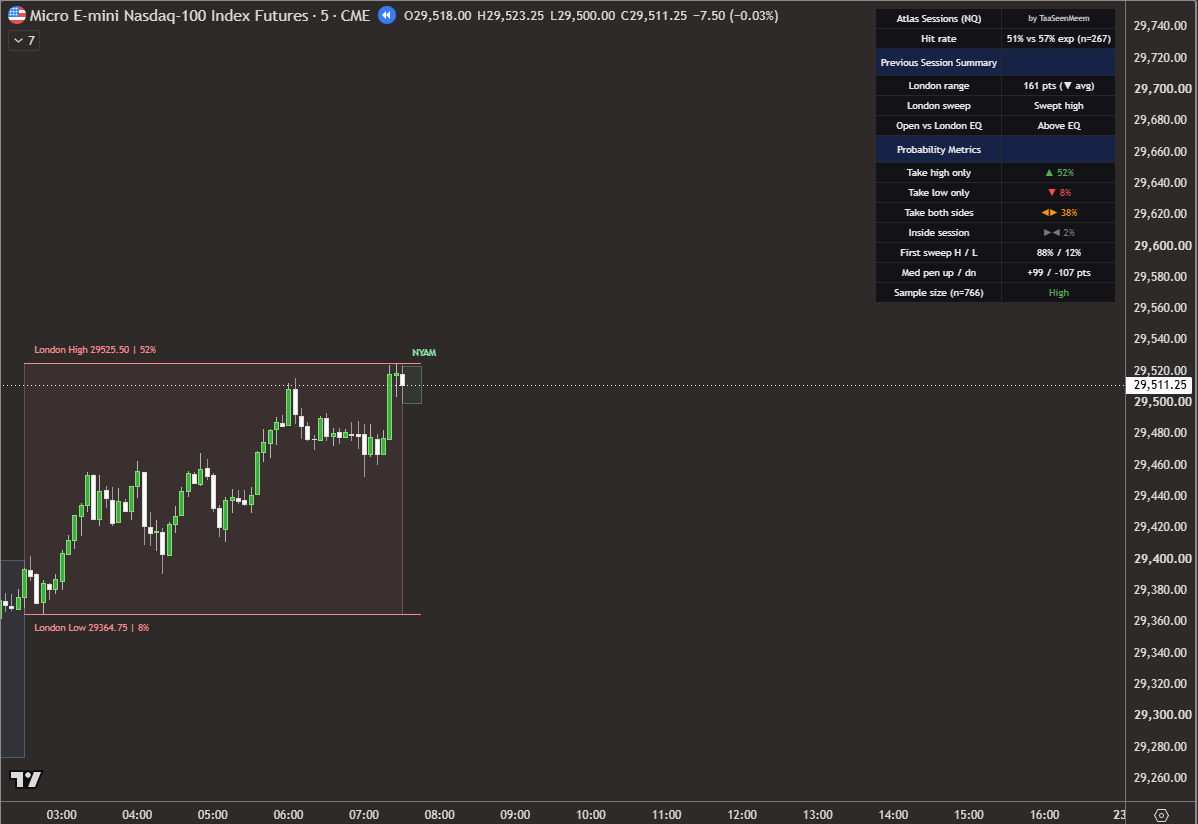
Friday 21 August 2026, NY AM opening at 07:30 on NQ: a 161 point London range, price pressed against the London high at 52 percent with the low 160 points below at 8 percent, first sweep 88 to 12 favouring the high, the same table as Tuesday 4 August.
07:30 open
London high 29525.50 at 52%, low 29364.75 at 8%. Price pressed against the high at the open. Tuesday 4 August's table.
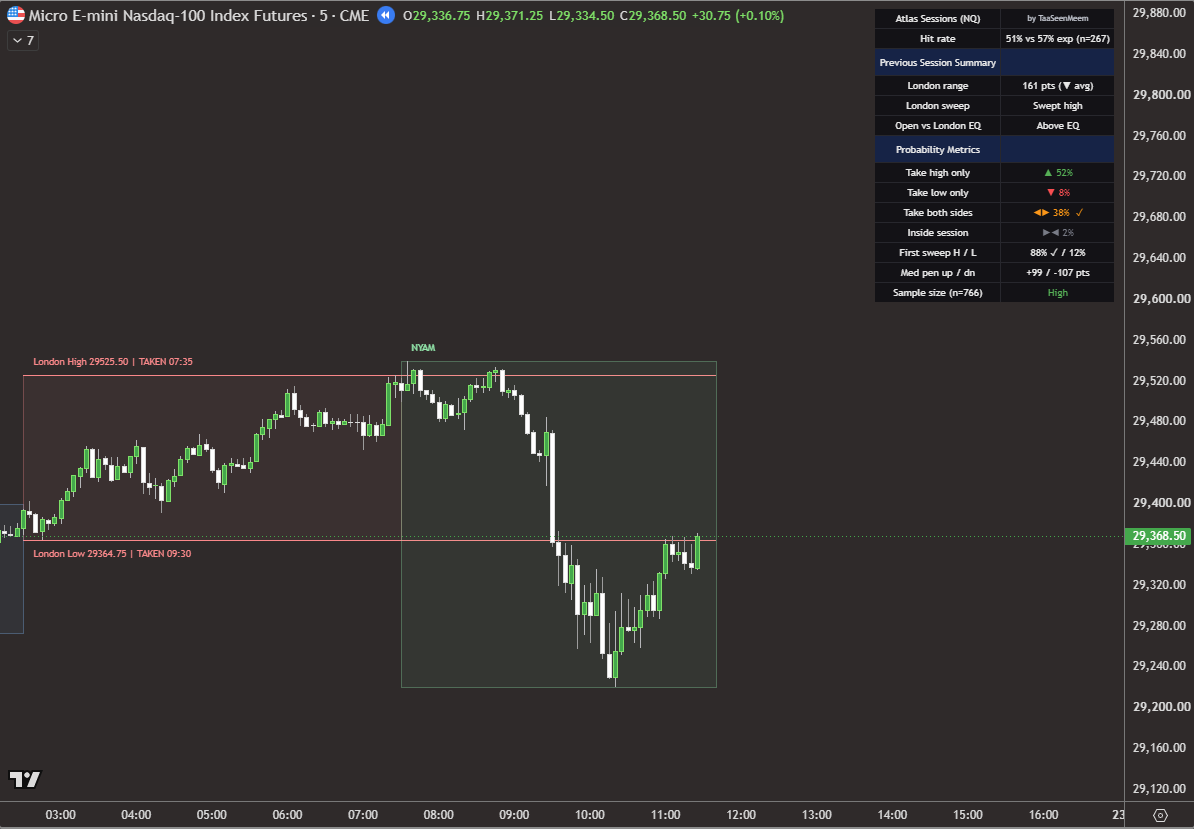
Friday 21 August 2026, NY AM at the close: the London high latched taken at 07:35, price holding near it until 09:15 and then falling 300 points through the low at 09:30 to 29230 before recovering into the close. Both levels taken.
11:30 close
High taken 07:35, then a 300-point reversal took the low at 09:30. Both sides, the 38% branch.
Friday 21 August

Tuesday 4 August's forecast, the high at once, then a 300-point reversal took the low

First sweep ✓ · both sides, the 38% branch

Price opened pressed against London's high with 88% on it going first, and it went at 07:35. The table is Tuesday 4 August's, 52 / 8 / 38 / 2 from 766 sessions, and that morning the high went at 07:30 and nothing else did.

This one held near the high until the cash open and then fell three hundred points in an hour, through the low at 09:30, before recovering. Both sides, the 38% branch; high only at 52% was the favourite and did not land. Two from two on the marginals, the 90% high and the 46% low both taken. The flash PMIs printed at 09:45 ET, inside the session; they were a low-impact release that week and the move was already under way.

  • London range161 pt, below average
  • Prior sweepSwept high
  • Open vs London EQAbove EQ
  • Four-way52 / 8 / 38 / 2
  • First sweep▲ 88% · ▼ 12%
  • P(high taken)90% → taken 07:35
  • P(low taken)46% → taken 09:30
  • Samplen 766, High
The most useful thing in the record

The same forecast, more than once

Across the fifteen sessions published so far, six context bins have each come up more than once, and fourteen of the fifteen sessions sit in one of them. Same context bin, same lookup, same numbers to the percentage point, on days weeks apart with different London ranges and different price levels. This week every session was a repeat: one pair repeated within the week, and three sessions drew tables the first two weeks had already produced.

ForecastSessionsFirst sweepOutcome
38 / 11 / 50 / 1 · sweep 80 / 20 · n 524Fri 7 Aug▲ high 80%high only
Wed 12 Aug▲ high 80%high only
Fri 14 Aug▲ high 80%both sides
34 / 25 / 41 / 0 · sweep 58 / 42 · n 528Wed 5 Aug▲ high 58%both sides
Thu 6 Aug▲ high 58%both sides
Tue 11 Aug▲ high 58%low only
28 / 15 / 56 / 1 · sweep 58 / 42 · n 173Thu 13 Aug▲ high 58%both sides
Mon 17 Aug▲ high 58%low only
24 / 45 / 25 / 6 · sweep 38 / 62 · n 406Tue 18 Aug▼ low 62%low only
Wed 19 Aug▼ low 62%both sides
10 / 52 / 38 / 0 · sweep 15 / 85 · n 840Mon 3 Aug▼ low 85%both sides
Thu 20 Aug▼ low 85%low only
52 / 8 / 38 / 2 · sweep 88 / 12 · n 766Tue 4 Aug▲ high 88%high only
Fri 21 Aug▲ high 88%both sides

Two things follow, and they matter more than this week's score.

The forecast is a lookup, not a fit. Nothing about Wednesday the 19th was used to produce Wednesday the 19th's numbers. They are the numbers Tuesday got, because both sessions landed in the same measured bin, and the same is true of the three tables this week borrowed from the first two. A table that returns the same answer for the same context bin and then watches the answer resolve both ways is behaving exactly as a table should.

Identical forecasts resolving differently is the system working, not failing. Of the six bins that have repeated, four have now produced more than one outcome. A 56% both-sides figure that landed every time would be evidence the number was wrong; one from two is what 56% looks like at this sample size, and so is two from two. Neither settles anything; both are the point.

What this week actually shows

Four things, from a week that was neither the best nor the worst of the three.

  1. Every forecast this week was a repeat, and the repeats split. Monday drew Thursday 13 August's table and did the opposite. Tuesday and Wednesday drew the same table and did opposite things. Thursday drew Monday 3 August's and did the opposite. Friday drew Tuesday 4 August's and did the opposite. Four repeated bins, four different outcomes from the earlier draw; only Wednesday 19 August on gold, elsewhere on this site, repeated its predecessor. That is a table of shares doing what shares do, and it is published because it is the clearest thing three weeks can show.
  2. The both-sides favourite appeared once and lost, which leaves it four from nine. Both sides has been the highest-rated branch on nine of the fifteen mornings published and has landed on four of them. A week is too short to call that a calibration problem, and so is three, but it is the kind of thing that would show up as one if it kept happening, which is what the running record exists to catch.
  3. The per-side view again carried the sessions the branch score buried. Monday, Wednesday and Friday all score zero on the four-way axis and two from two, or one from two, on the per-side one. Seven of ten levels resolved as their marginals implied, against a mean stated 67%, and twenty-two of thirty across the three weeks against roughly 70%. If you trade one level at a time rather than betting the branch, that remains your column.
  4. Fifteen sessions still settle nothing, and the indicator's own row is behind. Thirty level events cannot confirm frequencies measured over hundreds. The indicator's realised versus expected row read 51 to 53% against 57% expected across the week, on roughly 265 to 280 setups loaded, which is behind for the third week running. Three weeks in, the honest summary is that the record has a shape, not a verdict, and that row is the number to keep watching.
How to check this yourself. Load Atlas Sessions on your own NQ chart, set it to any timeframe you like, and scroll back to the week of 17 August 2026. The levels and percentages will be the ones printed above, because they are fixed table lookups rather than anything computed from what happened next. Compare Tuesday's table with Wednesday's while you are there, and then with Monday 3 August and Tuesday 4 August.